
Ostara Blessing: Heartfelt Words + a Simple Ritual for 2027
An Ostara blessing is a short spoken or written wish that welcomes the spring equinox, honoring renewal, balance, and the returning light. If you have ever stared at a blank card on March 20 wanting words that feel sincere, you know how hollow generic greetings can feel.
Drawing on seasonal folklore, Wheel of the Year traditions, and ritual practice, this guide offers heartfelt blessings, a simple seed ritual, and the honest history behind Ostara. Whether you celebrate solo at an altar or with family, you will find words that fit. Every blessing here is original, and every date is checked for 2027.
[Author note: add one real sentence of your own Ostara memory here, plus a byline and “last updated” date.]
Ostara Blessings Meaning: Symbolism Explained
An Ostara blessing carries the season’s symbols: eggs for potential, hares for fertility, seeds for patience, and equal day and night for balance. Each image gives your words weight, which is why a blessing about a seed feels richer than a generic wish for happiness.
The name traces to Eostre, an Anglo-Saxon goddess the monk Bede mentioned around 725 CE, and Jacob Grimm later reconstructed “Ostara” in 1835. Modern Ostara sits on the Wheel of the Year, largely shaped in the twentieth century, so today’s blessings blend old folklore with new devotion.
| Symbol | Traditional meaning | Blessing idea |
| Egg | Potential, new life | “May my quiet ideas finally crack open.” |
| Hare | Fertility, swift new energy | “Quick as the hare, may good news find me.” |
| Seeds | Patience, intention | “What I plant in faith, let it take root.” |
| Equal day and night | Balance | “May my rest and my work stand even.” |
| Crocus, daffodil | First hope after winter | “Let hope be the first thing to bloom.” |
Ostara 2027 at a glance: the equinox arrives Saturday, March 20, 2027, at 4:25 p.m. EDT (20:25 UTC).
| Detail | 2027 |
| Date | Saturday, March 20 |
| Eastern / Central | 4:25 p.m. EDT / 3:25 p.m. CDT |
| Mountain / Pacific | 2:25 p.m. MDT / 1:25 p.m. PDT |
| US daylight saving begins | March 14, 2027 |
| Southern Hemisphere | Ostara falls in September |
Pagan Ostara Blessings: Honoring Ancient Roots
Pagan Ostara blessings usually call on the turning wheel, the returning sun, and the earth’s fertility, often closing with “blessed be.” Solitary practitioners and covens alike use them to open a circle, bless an altar, or thank the land for waking after winter.
Be honest about the lineage, though. No surviving source confirms that ancient worshippers spoke these exact words, and that is fine. A blessing becomes meaningful through intention, not antiquity, so write in your own voice and let the old symbols carry the weight.
- “The wheel has turned and the light grows long. By seed and flame, by hare and dawn, bless this house and all who cross its threshold. Blessed be.”
- “Earth beneath me, waking slow, hear the wish I plant below. As the egg opens, so may I. So mote it be.”
- “Lady of the first gold morning, walk beside me into spring.”
- “Green Man, rising in the roots, send your strength to every shoot.”
- “Where shadow ends and brightness starts, bless the courage in my heart.”
Ostara Ritual & Blessing for New Beginnings
If you want a blessing you can do rather than only read, try a seed ritual. It takes about ten minutes, needs little more than soil and a candle, and turns a vague hope into something you can water. Planting makes your intention tangible, like a promise with roots.
Picture a Saturday morning in late March: frost still silvering the porch rail, a small pot on the windowsill, one sleepy person whispering a wish to a handful of basil seeds. It looks ordinary, yet that small act is often what makes the season feel real.
Materials
Gather a small pot or recycled jar, potting soil, a pinch of seeds such as basil or marigold, a candle in green or yellow, a slip of paper, a pen, and a cup of water. Keep everything simple; the intention matters more than the props.
Instructions
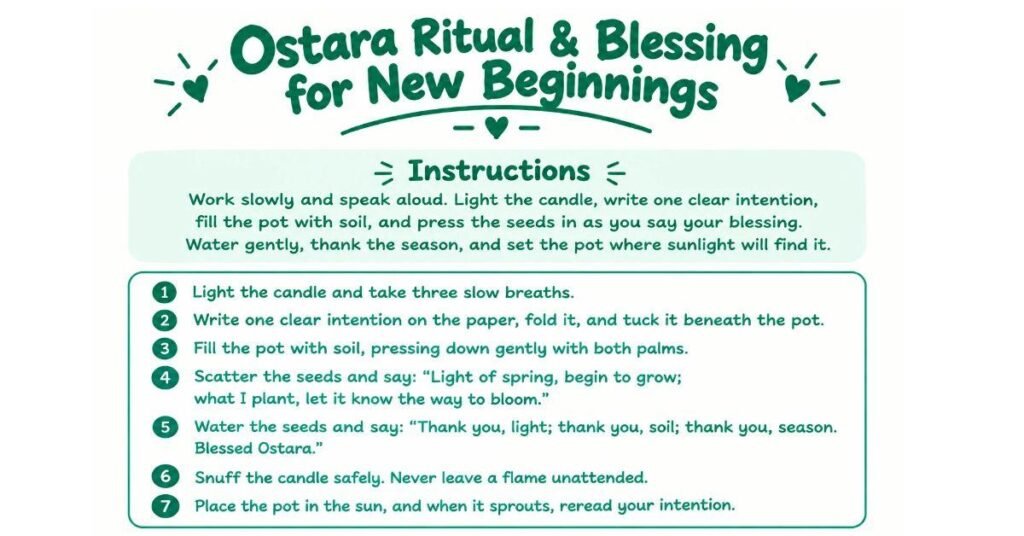
Work slowly and speak aloud. Light the candle, write one clear intention, fill the pot with soil, and press the seeds in as you say your blessing. Water gently, thank the season, and set the pot where sunlight will find it.
- Light the candle and take three slow breaths.
- Write one clear intention on the paper, fold it, and tuck it beneath the pot.
- Fill the pot with soil, pressing down gently with both palms.
- Scatter the seeds and say: “Light of spring, begin to grow; what I plant, let it know the way to bloom.”
- Water the seeds and say: “Thank you, light; thank you, soil; thank you, season. Blessed Ostara.”
- Snuff the candle safely. Never leave a flame unattended.
- Place the pot in the sun, and when it sprouts, reread your intention.
Ostara Blessings For Balance And Harmony
The equinox is the one day when light and dark meet nearly as equals, which makes it the perfect moment to bless your own balance. Many people reach Ostara tired from winter, so a blessing for calm can feel more honest than one for excitement.
Say a balance blessing at dusk, when the day hands over to the night. Pair it with three slow breaths and an unclenched jaw. Harmony rarely arrives dramatically; it settles in quietly, the way evening light softens a kitchen table.
- “May my days hold light and shadow equally, and may I meet both without fear.”
- “As the sky balances tonight, may my work and rest make peace with one another.”
- “Steady hands, steady heart, soft shoulders. Let this equinox settle in me.”
- “Let what is heavy settle, and what is light rise.”
- “At this crossing of night and day, I choose peace, and I choose it again tomorrow.”
Ostara Blessings For Love And Relationships
Spring is a forgiving season for love. Seeds do not bloom overnight, and neither do trust or tenderness. An Ostara blessing for a partner works best when it names something specific, such as patience during hard weeks or laughter returning to the house.
Hares and eggs have long stood for fertility, but you do not need that meaning to bless a relationship. Read the words over dinner, tuck them into a card, or whisper them at the doorway. Small, sincere gestures strengthen connection more than grand declarations ever do.
- “May our home be a garden we tend together, forgiving the weeds and celebrating every bloom.”
- “May the love we planted last year return stronger, rooted in patience and laughter.”
- “Bless the person beside me; may spring remind us how to begin again, gently.”
- “May we speak kindly, listen longer, and laugh often as the days stretch out.”
- “Where winter made us quiet, let spring make us tender.”
Ostara Blessings For Home, Nature, And The Garden
Opening the windows is half the blessing. Stale winter air leaves, birdsong enters, and the house begins to feel like a living place again. Walk room to room while you speak. A home blessing at Ostara asks for warmth, safety, and welcome at every threshold.
Gardeners can extend the blessing outdoors. Press seeds into prepared soil, touch the first crocus, or bless your tools before the season’s work begins. Even a balcony herb box counts. What matters is the pause, that moment of noticing the earth waking beneath your hands.
- “Bless these windows, open to the morning; bless these doors, wide for welcome; bless this table, always set for kindness.”
- “May this garden wake gently, may the soil be generous, and may every seed find its way to light.”
- “Warmth in the walls, peace in the rooms, and birdsong at the sill.”
- “Sweep out the stale, welcome the fresh, and let sunlight find every corner.”
- “May this home be a nest for the weary and a lantern for the lost.”
Ostara Blessings For Abundance, Prosperity, And Growth
Abundance at Ostara is less about windfalls and more about fertile ground: skills, savings, friendships, and ideas ready to grow. A prosperity blessing works best when it pairs a wish with one small action, such as updating a budget or sending that overdue application.
Think of it as planting rather than wishing. Seeds need soil, water, and time, and so do goals. Speak your blessing aloud, write the first step on paper, and place it beside a plant that will grow through spring alongside your intention.
- “May the work I begin this spring be fruitful, and may what I give return in many forms.”
- “Let my effort be the seed, my patience the water, and the season my teacher.”
- “May there be enough, and a little more to share.”
- “May my hands be steady, my work honest, and my harvest shared.”
- “I plant courage today; may it grow into opportunity.”
Short Ostara Blessings
Short blessings travel well. They fit inside a text, a card, or an Instagram caption, and they are easier to remember at a sunrise gathering. Aim for one clear image and one wish, and let the silence around the words do the rest.
Brevity also helps when you are shy about spiritual language. A single line such as “seeds are listening” says plenty without asking the listener to share your beliefs. Choose the version that sounds like you, then adjust a word or two until it fits comfortably.
Simple Ostara Blessings: Easy & Meaningful
Simple blessings suit beginners and busy mornings. Try them while the kettle heats, as you water a plant, or before opening the front door. Repetition matters more than polish, so choose one line and say it daily through the equinox week.
- Open the window; let the morning in.
- Begin small. Begin anyway.
- Roots first, blossoms later.
- The light is lengthening, and so is hope.
- May your table be full and your doorway wide.
- Steady as the equinox, soft as new grass.
- Thaw gently.
- Plant it, then trust it.
Happy Ostara Blessings: Spreading Joy and Renewal
A Happy Ostara greeting is the friendliest way to share the season, especially with people who celebrate Easter or simply enjoy spring. Keep the tone warm and inclusive. Mention flowers, longer days, or fresh starts rather than doctrine, and your message will land gently anywhere.
For family and friends, personal beats polished. Add a name, a shared memory, or an inside joke. A cousin who just started a new job may love a blessing about open doors, while a tired friend may need one about rest.
Joyful Ostara Blessings
Joyful messages work best when they sound like you talking. Share a smile, mention the crocuses finally showing, and wish them a bright equinox. Cheerful, brief, and kind is the formula for any card, group chat, or social post this season.
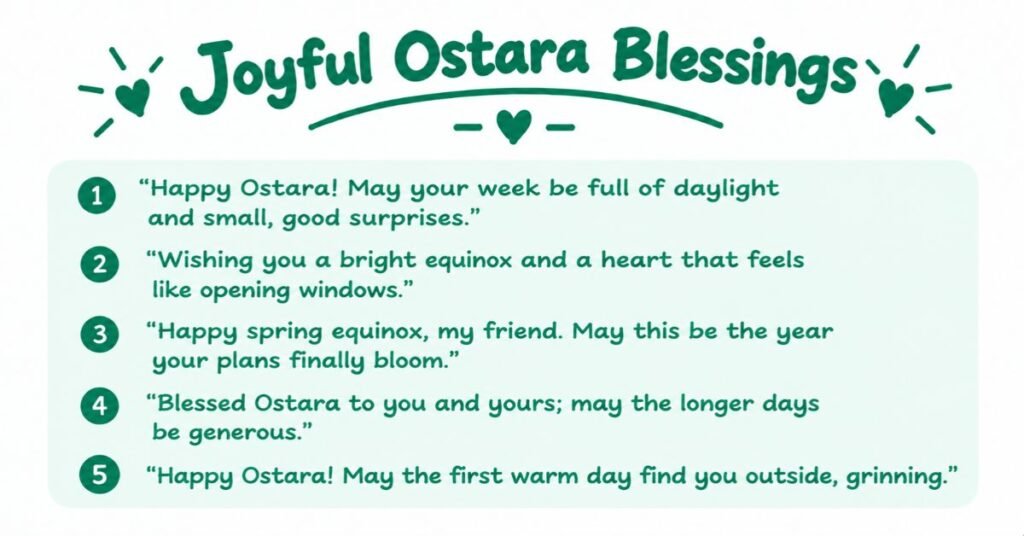
- “Happy Ostara! May your week be full of daylight and small, good surprises.”
- “Wishing you a bright equinox and a heart that feels like opening windows.”
- “Happy spring equinox, my friend. May this be the year your plans finally bloom.”
- “Blessed Ostara to you and yours; may the longer days be generous.”
- “Happy Ostara! May the first warm day find you outside, grinning.”
Ways To Share Ostara Blessings With Loved Ones
Handwritten cards still win. Slip a blessing into an envelope with a pressed flower or a pinch of seeds, and the gift becomes tactile and memorable. If distance separates you, record a thirty-second voice note so your tone carries the warmth.
Gatherings offer another path. Read a blessing before a spring meal, or invite each guest to name one thing they hope to grow. Children enjoy decorating eggs while someone reads aloud. Sharing this way turns a private wish into a small community tradition.
| Method | Best for | Tone |
| Handwritten card with seeds | Family, close friends | Warm, personal |
| Text message | Quick check-ins | Short, cheerful |
| Voice note | Long-distance loved ones | Intimate |
| Spring meal reading | Groups, households | Communal |
| Social post | Wider circle | Light, inclusive |
| Altar or journal | Solo practice | Reflective |
Ostara Blessings FAQs
What are Ostara blessings?
Ostara blessings are spoken or written wishes shared at the spring equinox. They celebrate renewal, balance, and returning light, and people use them in rituals, cards, prayers, and greetings. They come from modern pagan and Wiccan practice, yet anyone can borrow them respectfully.
When do people share Ostara blessings?
People share Ostara blessings on or near the spring equinox, which falls on Saturday, March 20, 2027, at 4:25 p.m. Eastern (20:25 UTC). Many also use them throughout the following week, at sunrise, during rituals, or when sending seasonal greetings.
Who can receive Ostara blessings?
Anyone can receive an Ostara blessing. Share them with family, friends, neighbors, or coworkers who enjoy spring, using inclusive wording such as ‘new beginnings’ or ‘returning light.’ If someone follows a different faith, a gentle seasonal wish is usually welcomed without any religious expectations.
How do you use Ostara blessings?
Speak them aloud at sunrise, over a candle or seed pot, or at a meal. Write them in cards, texts, and journals. Pair each with one small action, like planting, tidying, or calling a friend, so the words connect to something you can actually do.
Why are Ostara blessings meaningful?
They give the equinox a voice. Ostara blessings help you mark a threshold between winter and spring, name what you hope to grow, and feel connected to nature’s rhythm. That small ritual of attention often brings calm, gratitude, and a sense of fresh possibility.
Is Ostara the same as Easter?
No. Ostara is a modern pagan sabbat on the spring equinox, while Easter is a Christian holy day whose date depends on the Paschal full moon. In 2027, Easter falls on March 28, eight days after the equinox. They share spring imagery but different meanings.
Was Ostara a real goddess?
Evidence is thin. Bede mentioned Eostre around 725 CE, and Grimm reconstructed “Ostara” in 1835, yet no other early source confirms her worship. Scholars still debate her, while modern pagans honor Ostara as a living symbol of spring.
Do you have to be pagan to celebrate Ostara?
No. Ostara marks observable changes: lengthening days, returning birds, and sprouting plants. You can celebrate with a walk, a planted seed, or a quiet moment of gratitude, whatever your faith or background, as long as you treat its pagan roots with respect.
Is Ostara in September in the Southern Hemisphere?
Yes. South of the equator the spring equinox arrives in September, so Ostara is celebrated then, while Mabon falls in March. Australian and New Zealand readers should shift every date in this guide by about six months to match their seasons.
Ostara Blessings: Conclusion
An Ostara blessing does not need to be ancient, long, or perfect. It needs to be sincere. Whether you plant seeds at dawn, bless a home, or text a friend two honest lines, you are joining a seasonal tradition of noticing renewal.
Mark Saturday, March 20, 2027, choose one blessing from this guide, and say it aloud. Then let spring do what it always does: arrive slowly, then all at once. May your Ostara blessings take root and bloom long after the equinox.