Blessing a House: Easy Steps, Prayers & Bible Verses
Blessing a house means inviting peace, protection, and God’s presence, or your own sacred intention, into your home through prayer, scripture, or a simple room-by-room walk. After studying Catholic, Protestant, Hindu, Buddhist, and secular house blessing ceremony traditions, I can tell you it needs no special training, only a sincere heart.
Maybe you just closed on your first place, and the boxes feel strange instead of joyful. Or life has felt heavy lately. Either way, you want a home that feels safe, not just furnished. Below, you’ll find clear steps, prayers for each room, holy water, anointing oil, and Epiphany customs, so your move-in day feels meaningful. You can also speak a blessing for today over your home each morning.
What Is Blessing a House?
Blessing a house is the act of asking for peace, protection, and care over a home and everyone who lives there. Wikipedia notes these rites go by many names, including house cleansing, house healing, and space clearing, and many religions practice some version of them.
It isn’t magic, and it isn’t about worshiping walls. For Christians, it’s a prayer for God’s guidance over the household; for others, a ritual of intention. As Fox News reported, you need little beyond a dwelling and a sincere purpose to begin.
Blessing a House in the Bible
Scripture offers no formal ritual manual, yet it keeps returning to the household. Joshua 24:15 pledges that “my house” will serve the Lord, and Psalm 127:1 warns that builders labor in vain unless God builds the home itself, a verse many families pray at the front door.
Deuteronomy 6:9 told Jewish households to write God’s words on doorposts, which became the mezuzah. In Luke 10:5, Jesus tells his disciples to greet a house with “Peace be to this house.” Many modern blessings simply echo those two instincts: words at the threshold.
Blessing a House in Christianity
In Roman Catholic, Lutheran, Anglican, Methodist, and Orthodox traditions, a pastor or priest typically walks through every room with the family, praying and sometimes sprinkling holy water. Some Christians also trace a cross in holy oil on doors and windows to invite protection.
Epiphany, January 6, is the classic date. Many homes begin by chalking the door with the year and the letters C, M, and B, honoring the Magi or the Latin blessing Christus mansionem benedicat. For 2027, the inscription reads 20+C+M+B+27.
Blessing a House in Hinduism
In Hinduism, a house blessing is always conducted before the family moves in, whether the home is newly built or purchased. A Hindu priest performs it, and the details vary widely across India. The core idea stays constant: sanctify the space first, then live there.
In Gujarat, the blessing mainly involves abhisheka, a ritual milk-bathing of a murti, frequently Lord Ganesha, while the priest chants mantras. In Tamil Nadu, the tradition includes mantras, escorting a cow through each room, and boiling its milk in the kitchen.
Blessing a House in Mahayana Buddhism
Within Mahayana Buddhism, Han Chinese families, from China to Taiwan, commonly purify a new residence with water chanted over using the Great Compassion Mantra, a rite called sajing. Laypeople can lead it themselves, or they can invite monastics to officiate.
Some believers also arrange, before moving in, a memorial service at a temple for the property’s local land deity, hoping it becomes a benevolent presence. It shows how blessing a house can honor unseen neighbors, not only the people moving in.
| Tradition | Typical elements | Who leads |
| Catholic, Lutheran, Anglican, Methodist, Orthodox | Prayers, holy water, sometimes blessed salt or incense | Priest or pastor, or the family |
| Epiphany custom (Jan 6) | Chalking the door, prayer at the home altar | The household |
| Latter-day Saints | Called a “home dedication” | Church-directed |
| Hindu | Mantras, abhisheka, cow and milk rites (Tamil Nadu) | Hindu priest, before move-in |
| Han Chinese Mahayana Buddhist | Water chanted with the Great Compassion Mantra (sajing) | Laypeople or monastics |
| Secular or spiritual | Cleaning, candle, salt, spoken intention | You |
Blessing a House Step by Step: How to Do a House Blessing
Here’s the good news: you can do this yourself. Traditionally a minister or priest led the rite, but you can pray alone, with a spouse, or with friends. The steps below follow a simple prayer-walk flow that works for new homes and long-lived ones.
Set aside fifteen to thirty minutes, silence your phone, and bring only what feels meaningful: a candle, a Bible, olive oil, or holy water from your parish. Nothing is mandatory. The sincerity of your prayer matters far more than the props.
Remove Negative Items
Before praying, walk through and notice anything that doesn’t fit the peace you’re inviting. For some Christians that means books, games, or décor with dark or occult themes. Others simply declutter and clean. Decide prayerfully, keep it gentle, and remember this step is about intention, not fear.
Gather Loved Ones (Optional)
Invite family or close friends who share your purpose. Shared prayer turns a quiet ritual into a memory, and it helps younger kids feel part of the celebration. Assign small parts, one verse each, so everyone feels included. If you’d rather go solo, that works beautifully too.
Pray Through Each Room
This is the core of the ceremony, commonly called a prayer walk. Begin downstairs, then work upward, pausing at every threshold, window, and storage nook to speak a short blessing. End outdoors by acknowledging the yard or building perimeter as part of your home.
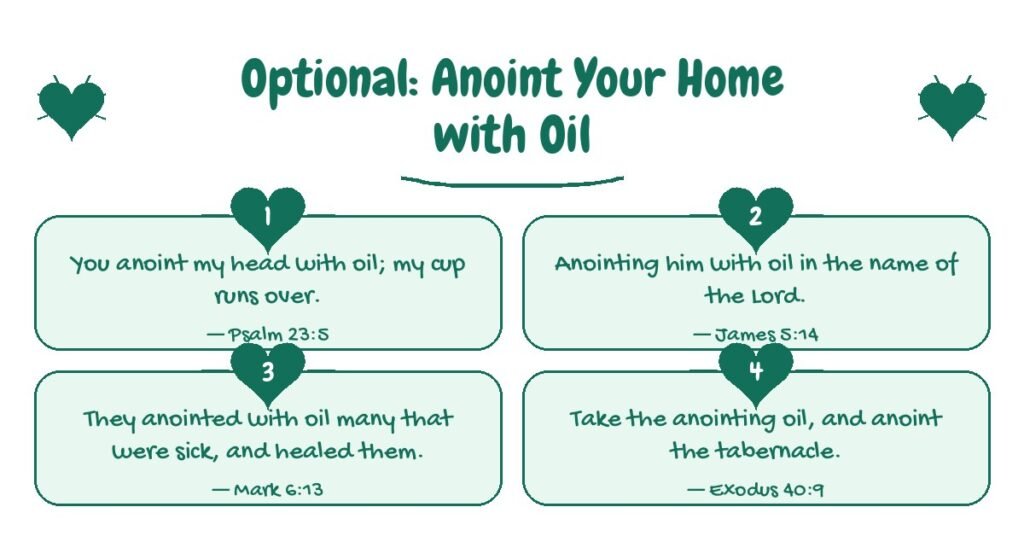
Optional: Anoint Your Home with Oil
Anointing is symbolic, not required. Many Christians dedicate a little olive oil in prayer, then touch a small cross to door frames and window sills. Wikipedia notes that people of various denominations have traced crosses with holy oil on lintels to invite protection.
Dedicate Your Home to God
Close with a short prayer of dedication, committing the home and everyone in it to God. Keep it personal: thank Him for shelter, ask for peace and hospitality, and invite guests into a welcoming space. Many families close with Aaron’s blessing from Numbers 6:24–26. Then pause in silence for a moment before blowing out the candle.
Not religious? Replace “God” with your own words: speak your intention aloud, such as “May this home be a place of peace, rest, and welcome.”
| Step | What you do | Time |
| Remove negative items | Declutter; set aside items that clash with your values | 15–30 min |
| Gather loved ones | Invite family or friends; assign readings | 5 min |
| Pray through each room | Walk bottom to top, one short blessing per space | 15–20 min |
| Anoint (optional) | Touch a small oil cross to door frames | 5 min |
| Dedicate | Closing prayer, candle, toast | 5 min |
Blessing a House Room by Room: Prayers & Bible Verses for Each Room
Praying room by room makes the blessing specific, which keeps it from feeling generic. Match each prayer to how the space is used: welcome at the entrance, nourishment in the kitchen, connection in the living room, rest in the bedroom. Read slowly, and let family members take turns.
The prayers below are original, written in the spirit of traditional Catholic and Protestant house blessings. Pair each with a verse if you like. Catholic parishes, such as Holy Trinity in Beaverton, Oregon, even invite parishioners to take holy water from the baptismal font for home use.
Entrance (Prayer of Protection)
Begin at the front door, where you cross from the world into your sanctuary. Speak a greeting of peace, perhaps echoing Luke 10:5 or Romans 15:7, and ask for protection over everyone who comes and goes. Place a hand on the doorframe if it feels natural.
Lord, guard our coming and going. Make this doorway a place of welcome, safety, and peace for family, friends, and strangers alike. Amen.
Kitchen/Dining Room (Prayer for God to Meet Our Needs)
The kitchen is where daily bread becomes shared life, so pray here for gratitude and generosity. Joel 2:26 speaks of eating in plenty and praising God. Ask that no one in the home goes hungry and that the table stays open to guests.
Thank you for this food and this table. Provide what we need, make us generous, and let every meal here be shared with gratitude. Amen.
Family Room/Living Room (Prayer for Relationships)
Here you pray over conversations, screens, laughter, and the occasional argument. Philippians 4:8 invites us to dwell on what is true, lovely, and honorable. Ask for patience, kind words, and presence with one another, even when phones and televisions compete for attention.
Bind us together in patience and kindness. Let our words build up, our laughter ring out, and our screens never replace one another. Amen.
Bedrooms (Prayer for Peace & Sleep)
Bedrooms deserve gentle, quiet prayers about rest, healing, and safety. Psalm 4:8 says, in effect, that peaceful sleep comes from trusting God’s care. Pray for restful nights, tender dreams, and comfort for anyone carrying worry. Children’s rooms can be the most touching stop on the walk.
Watch over us as we sleep. Quiet our worries, heal what is weary, and let us wake rested and grateful. Amen.
Closing (Prayer for Shelter)
Gather everyone in the center of the home for a final prayer of thanks and shelter. Joshua 24:15 and Psalm 127:1 both fit well here. Ask that the house be a refuge when you’re home, a companion while you’re away, and a welcome when you return.
Be our shelter at home, our companion away, and our welcome when we return. Let peace live here. Amen.
| Room | Prayer focus | Verse to pair |
| Entrance | Protection and welcome | Luke 10:5; Romans 15:7 |
| Kitchen/Dining | Gratitude, provision | Joel 2:26 |
| Living Room | Relationships, peace | Philippians 4:8 |
| Bedrooms | Rest, safety | Psalm 4:8 |
| Closing | Shelter, dedication | Joshua 24:15; Psalm 127:1 |
Why Do a House Blessing? The Case for Blessing a House
People bless homes for comfort as much as conviction. A move, a loss, a new baby, or a hard season can leave a house feeling unsettled, and a spoken blessing marks a fresh start. Home Made Lovely describes it as inviting God’s peace, protection, and guidance.
Real estate agents see this too. Los Angeles agent Chantay Bridges said in a Fox News report that she has watched clients walk a home and pray that the owners accept their offer. Whatever your beliefs, the ritual slows you down and turns a purchase into a meaningful beginning.
Blessing a House and the Question: Can a House Be Demon-Possessed?
Christian teachers differ on this. Some believe spiritual darkness can take root where occult practices occurred; others say a blessing asks for God’s care, not to expel ghosts. Sara Borgstede notes her 1910 home was blessed for protection and guidance, not to ward off particular spirits.
A house blessing is not an exorcism. If you feel genuinely unsafe or distressed, speak with your pastor or priest, and consider talking to a counselor or doctor too. For most families, the goal is simpler: a peaceful, prayerful home without fear.

Blessing a House: A Family’s House Prayer Story
Picture a young couple unlocking their first home on a rainy Saturday. Boxes are stacked, nothing is hung, and the quiet feels almost too big. They light one candle, hold hands at the door, and read a short prayer aloud, laughing when their voices wobble.
Room by room, the house changes. Not magically, but emotionally: it becomes theirs. Afterward they share a toast and dessert, as Sara Borgstede’s family did. That’s the real power of blessing a house: it turns an address into a home you’ll protect, enjoy, and share.
Frequently Asked Questions
What are the steps to bless a house?
Clean and declutter first, then gather anyone who shares your purpose. Walk through the home from the front door, praying a short blessing in each room. If you wish, anoint the door frames with a little oil, and finish with a closing prayer of dedication. The whole blessing takes about 15 to 30 minutes.
What do you say when blessing a house?
Keep it simple and sincere. Many people greet the house with the words of Luke 10:5, ‘Peace be to this house,’ thank God for the home, and ask for protection and provision room by room. Close by dedicating the house to God, as in Joshua 24:15: ‘As for me and my house, we will serve the Lord.’
Which Bible verses are best for blessing a house?
Favorites include Joshua 24:15 for dedication, Psalm 127:1 for trusting God as the true builder and protector of the home, Psalm 4:8 for peaceful sleep, Luke 10:5 for a greeting of peace at the door, and Deuteronomy 6:9 for placing God’s words on the doorposts.
Who can bless a house? Do I need a priest or pastor?
Anyone can bless their own home; no priest or pastor is required. Many traditions do invite clergy to lead, and Catholic, Lutheran, Anglican, Methodist, and Orthodox churches often offer house blessings, but a prayer led by you or your family is just as valid.
How do you anoint a house with oil?
Use a small amount of olive oil. Many Christians first pray over the oil to dedicate it, then touch a tiny cross on the door frames — especially the front door — while praying for protection. Anointing is symbolic and completely optional.
When is the best time to bless a house?
The most common time is right after moving in, before the home fills up. Many families also bless their home at Epiphany on January 6, on New Year’s Day, after a hard season or loss, or when a new baby or housemate arrives.