Little Blessing Preschool: Programs, Learning & Enrollment
Little Blessing Preschool is a name associated with early childhood education, nurturing classrooms, and helping young children develop essential skills before kindergarten. Families searching for a little blessing preschool often want to understand its educational programs, preschool curriculum, teachers, classroom activities, schedules, enrollment requirements, and learning environment. Preschool provides children with opportunities to explore new ideas, develop friendships, practice communication, and build confidence through age-appropriate learning experiences.
Choosing the right preschool is an important decision for parents. A child’s first educational experience can influence their attitude toward learning, independence, social interaction, and emotional development. A supportive early learning environment encourages curiosity, creativity, kindness, and discovery. Families should carefully evaluate a preschool’s programs, teaching philosophy, safety practices, class schedules, and educational approach before deciding where their child will begin their learning journey. For the meaning behind the word “blessing” in the school’s name, see what the blessing of the Lord means.
Quotes
- “Every child’s learning journey begins with a little curiosity, a lot of love, and a world of possibilities.”
- “A nurturing preschool gives children the confidence to explore today and the courage to discover tomorrow.”
- “The smallest steps in early learning can lead to the biggest achievements in a child’s future.”
Little Blessing Preschool – Our Programs
Little Blessing Preschool programs are generally associated with early childhood learning experiences designed to meet children’s developmental needs. Depending on the individual school’s location and educational philosophy, programs may include toddler classes, preschool, pre-kindergarten, enrichment activities, and kindergarten preparation. For help comparing nearby options, see our guide to Blessing Daycare: how to find, verify and choose the right one.
Little Blessing Preschool programs help children develop communication, creativity, problem-solving, social interaction, and early academic skills. Teachers introduce learning through stories, games, music, art, movement, classroom discussions, and hands-on experiences. These activities allow children to explore concepts naturally while becoming familiar with classroom routines.
Families should remember that preschool facilities using similar names may operate independently. Program availability, age requirements, schedules, tuition, and enrollment policies can vary significantly. Parents should contact the specific Little Blessing Preschool they are considering to obtain accurate information about its educational services and admission requirements.
Preschool Programs for Young Learners
Programs for younger children typically focus on exploration, sensory experiences, language development, social interaction, and independence. Children may participate in circle time, music, art projects, outdoor play, storytelling, and simple classroom activities.
The purpose of these experiences is to help children become comfortable in an educational setting while developing foundational skills. Teachers encourage children to express their needs, communicate with classmates, explore learning materials, and participate in activities at their own pace.
Preschool Programs for Older Children
Older preschoolers at Little Blessing Preschool may participate in more structured educational activities designed to prepare them for kindergarten. These may include letter recognition, counting, patterns, early writing, science exploration, creative projects, and group learning.
Teachers can gradually introduce classroom responsibilities and routines. Children may learn how to organize materials, follow instructions, complete simple tasks, participate in discussions, and work cooperatively with others.
Quotes
- “Learning becomes meaningful when children are encouraged to discover the world in their own way.”
- “A great preschool program builds confidence, friendships, and a lifelong love of learning.”
- “Every classroom activity is an opportunity for a child to grow, explore, and shine.”
Little Blessing Preschool – Early Education Enrichment
Early education enrichment provides additional opportunities for children to explore their interests and develop skills beyond traditional classroom activities. Enrichment programs may include music, movement, creative arts, nature exploration, storytelling, sensory activities, science projects, and educational games.
These activities help children discover new interests while strengthening communication, creativity, physical coordination, and cognitive development. A well-planned enrichment program allows children to participate in meaningful experiences without placing unnecessary academic pressure on them.
Preschool enrichment should be developmentally appropriate and enjoyable. Young children learn through active participation, repetition, imagination, and experimentation. Activities that allow them to touch, observe, create, move, and ask questions can support deeper understanding. The National Association for the Education of Young Children (NAEYC) explains what high-quality early learning looks like for families.
Creative Arts and Expression
Creative activities allow children to communicate ideas through painting, drawing, coloring, crafts, music, dramatic play, and movement. These experiences encourage imagination while helping children develop fine motor skills and confidence.
Art projects can also introduce basic concepts such as shapes, colors, patterns, textures, and spatial awareness. Children learn that creativity is not about producing perfect results but about exploring ideas and expressing themselves.
Music and Movement
Music can support language development, listening skills, rhythm, coordination, memory, and social interaction. Preschool children often enjoy singing songs, dancing, using simple instruments, following movement patterns, and participating in group activities.
Movement activities provide opportunities for children to develop balance, coordination, body awareness, and confidence. They can also help children release energy and transition more comfortably between classroom activities.
Hands-On Learning Experiences
Hands-on activities encourage children to investigate materials and discover how things work. Building blocks, puzzles, sensory bins, nature objects, sorting games, and simple science experiments can support curiosity and problem-solving.
Teachers can guide children through questions such as what they notice, what they think might happen, and how they can try something different. These experiences introduce early reasoning skills in a natural and enjoyable way.
Quotes
- “Creative learning gives little minds the freedom to imagine, experiment, and discover.”
- “Children learn more when their hands, hearts, and minds are all part of the experience.”
- “Every song, story, and art project can open a new door to discovery.”
Little Blessing Preschool – Preschool Curriculum
The Little Blessing Preschool curriculum provides a framework for learning activities, developmental goals, classroom experiences, and educational routines. A little blessing preschool may use a thematic curriculum, play-based learning, structured academic activities, or a combination of different teaching methods.
A quality curriculum should support the whole child rather than focus exclusively on academic performance. Preschool children need opportunities to develop language, social skills, emotional awareness, physical coordination, creativity, problem-solving, and early mathematics.
Curriculum planning often includes seasonal themes, classroom projects, storytelling, science activities, art, music, and group discussions. Teachers may adjust activities according to children’s interests, developmental abilities, and learning needs.
Early Literacy and Language
Early literacy activities help children become familiar with books, sounds, letters, words, storytelling, and communication. Teachers may read picture books, introduce alphabet activities, encourage conversations, sing rhyming songs, and provide opportunities for children to express their ideas.
Children do not need to master reading before kindergarten. Preschool literacy focuses on building foundational skills, including listening, vocabulary, understanding stories, recognizing letters, and developing an interest in books.
Mathematics and Problem-Solving
Preschool mathematics introduces concepts through everyday activities. Children may count toys, compare objects, identify shapes, recognize patterns, sort materials, and explore quantities.
Teachers can incorporate math into classroom routines, art projects, snack time, building activities, and games. These experiences help children understand that mathematics is part of the world around them.

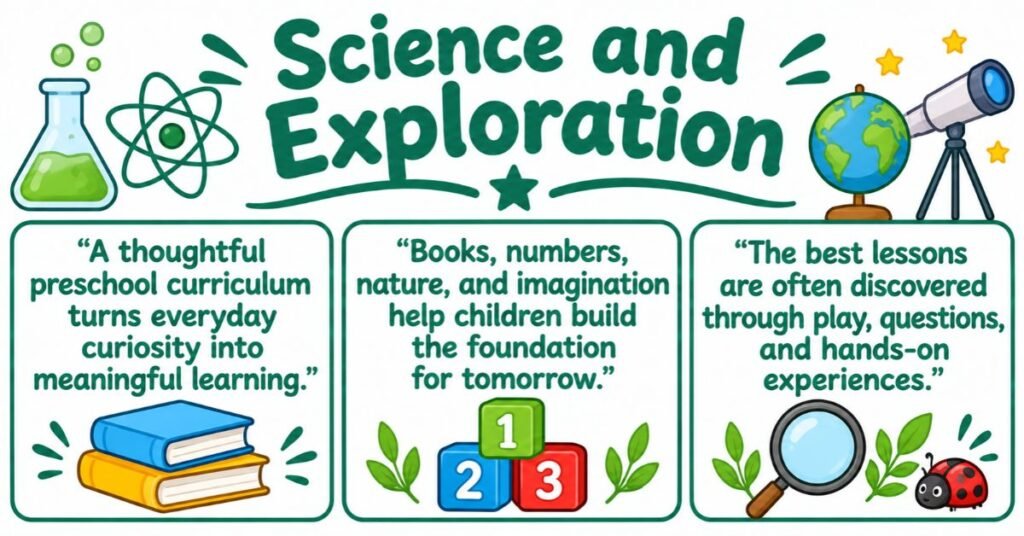
Science and Exploration
Science activities encourage children to observe, ask questions, experiment, and discover. Preschoolers may explore plants, animals, weather, water, magnets, light, shadows, and natural materials.
Teachers can encourage curiosity by allowing children to make predictions, compare observations, and describe what they notice. Simple experiments can introduce basic scientific thinking without requiring complicated explanations.
Quotes
- “A thoughtful preschool curriculum turns everyday curiosity into meaningful learning.”
- “Books, numbers, nature, and imagination help children build the foundation for tomorrow.”
- “The best lessons are often discovered through play, questions, and hands-on experiences.”
Little Blessing Preschool – Our Educational Philosophy
The educational philosophy of Little Blessing Preschool influences how teachers plan activities, interact with children, organize classrooms, and support developmental growth. Many early learning centers emphasize a nurturing, child-centered environment where children are encouraged to explore, learn, and develop at their own pace.
Children have different interests, personalities, strengths, and developmental needs. Some may enjoy creative activities, while others prefer puzzles, building, storytelling, outdoor play, or social interaction. Teachers should recognize these differences and provide opportunities that support individual growth.
A balanced educational philosophy combines structured activities with opportunities for independent exploration. Classroom routines help children feel secure, while play and discovery encourage creativity, independence, and problem-solving.
Learning Through Play
Play-based learning allows children to develop important skills through enjoyable experiences. During pretend play, children practice communication, imagination, cooperation, and social understanding.
Building activities can support spatial awareness, planning, and problem-solving. Games may help children develop counting skills, memory, listening, and turn-taking. Art and sensory activities encourage creativity and exploration.
Play should not be viewed as separate from education. It is one of the primary ways young children learn about themselves, other people, and their environment.
Individualized Learning
Children do not develop at exactly the same speed. Individualized learning recognizes each child’s abilities, interests, and developmental progress.
Teachers may provide additional guidance, adjust activities, encourage new challenges, or offer extra time when children need support. This approach helps children develop confidence without unnecessary comparisons.
Positive Classroom Relationships
A positive classroom environment encourages respect, kindness, communication, and cooperation. Teachers can model appropriate behavior and help children understand how to share, listen, express feelings, and solve disagreements.
Children benefit from consistent routines and supportive relationships. Feeling safe and valued can make them more willing to participate in learning activities and explore unfamiliar experiences.
Quotes
- “Every child deserves the freedom to learn at their own pace and the encouragement to reach their potential.”
- “A loving classroom creates the confidence children need to explore and grow.”
- “Play is not just fun; it is one of the most powerful ways children learn.”
Little Blessing Preschool – Programs for Two-Year-Olds
Little Blessing Preschool programs for two-year-old children generally focus on building trust, independence, language, movement, sensory exploration, and early social interaction. At this age, children are still learning how to communicate their needs, manage emotions, follow simple routines, and interact with other children.
A preschool environment for toddlers should provide safe spaces, age-appropriate toys, responsive teachers, and activities that allow children to explore without overwhelming them. Daily experiences may include music, storytime, sensory play, art, simple puzzles, movement, and outdoor activities.
Developmental Activities for Two-Year-Olds
Toddlers may participate in activities that help them recognize colors, identify familiar objects, explore shapes, practice simple words, and develop coordination.
Teachers can introduce activities using blocks, play dough, picture books, toy animals, water play, and pretend-play materials. These experiences support curiosity and allow children to learn through repetition.
At this stage, children may need assistance with transitions, sharing, classroom routines, and expressing emotions. Teachers should provide patience, encouragement, and clear guidance while helping toddlers become more independent.
Building Independence
Preschool activities can help two-year-olds practice simple tasks such as putting toys away, washing hands, choosing activities, carrying classroom materials, and participating in cleanup routines.
These small responsibilities can strengthen confidence and help children understand that they are capable of completing everyday tasks.
Parents should ask whether the preschool accepts children who are still learning toileting, how teachers handle separation anxiety, and what support is available during the adjustment period.
Quotes
- “Every little step toward independence is a beautiful achievement worth celebrating.”
- “Young children grow through gentle guidance, patient encouragement, and meaningful everyday experiences.”
- “A safe place to explore helps little learners discover how much they can do.”
Little Blessing Preschool – Programs for Three-Year-Olds
Three-year-old preschool programs typically provide more opportunities for group interaction, communication, creative activities, and structured classroom routines. Children begin developing stronger language skills and may become more comfortable participating in group learning experiences.
A little blessing preschool program for three-year-olds may include storytime, music, art, pretend play, counting, sorting, outdoor activities, and classroom discussions. Teachers can introduce educational concepts while allowing children to learn through exploration.
At this age, children may be learning how to share, take turns, express feelings, follow simple instructions, and participate in group activities. These skills are important for building positive relationships and preparing for future educational experiences.
Social Skills and Friendship
Little Blessing Preschool provides children with opportunities to meet classmates, practice communication, and develop friendships. Children may learn how to invite others to play, share materials, wait for turns, and cooperate during group activities.
Teachers can help children navigate common challenges, including disagreements, frustration, and difficulty sharing. Positive guidance allows children to understand social expectations while developing empathy and respect.
Early Academic Exploration
Three-year-olds may begin exploring letters, numbers, shapes, colors, patterns, and basic concepts through play.
Activities such as matching games, counting objects, painting, building, and storytelling can introduce early academic skills without creating pressure.
Teachers should encourage participation and curiosity rather than expecting every child to achieve the same milestones at the same time.
Communication Development
Children at this age often develop vocabulary and begin expressing more complex thoughts. Conversations, songs, stories, and group activities can support language development.
Teachers can encourage children to describe objects, explain their ideas, ask questions, and listen to classmates.
Quotes
- “Three-year-olds discover a bigger world through friendships, imagination, and playful learning.”
- “Every new word, shared toy, and little friendship helps a child grow.”
- “Encouragement turns everyday preschool moments into meaningful milestones.”
Little Blessing Preschool – Programs for Four-Year-Olds
Little Blessing Preschool four-year-old programs often place greater emphasis on kindergarten readiness while continuing to support social, emotional, physical, and creative development.
Children may participate in more structured group activities, early literacy exercises, mathematics, science exploration, art, music, movement, and collaborative projects. They may also practice following multi-step instructions, completing classroom tasks, and working with classmates.
A well-designed program should maintain a balance between academic preparation and enjoyable learning experiences. Children need opportunities to move, explore, ask questions, create, and develop confidence.
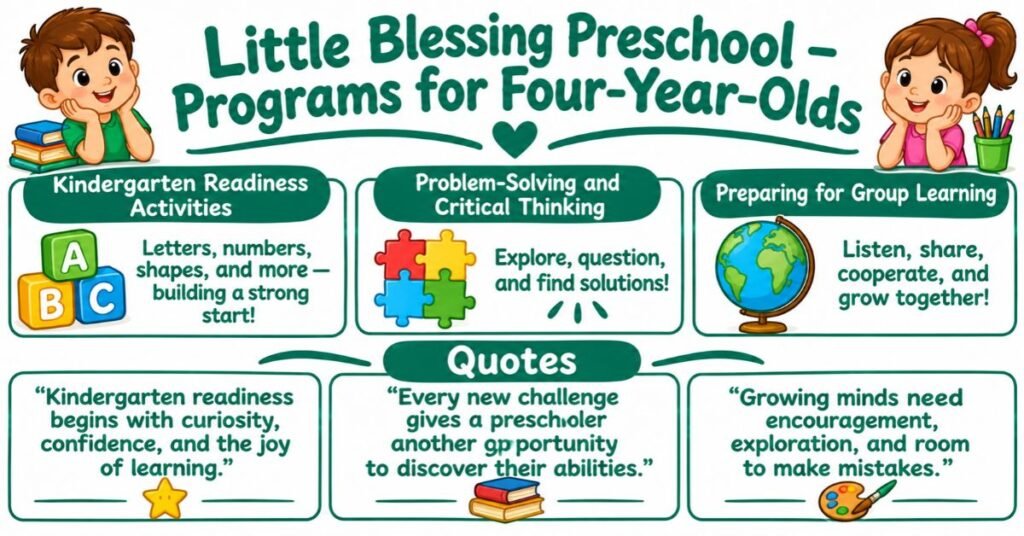
Kindergarten Readiness Activities
Kindergarten readiness may include recognizing letters, identifying numbers, counting objects, understanding shapes, developing vocabulary, listening to stories, and participating in classroom discussions.
Children may also practice holding crayons, drawing, using scissors with supervision, organizing materials, and completing simple activities independently.
These skills can help children become more comfortable with elementary school routines.
Problem-Solving and Critical Thinking
Four-year-olds may begin exploring more complex puzzles, building projects, sorting activities, patterns, and simple science experiments.
Teachers can encourage children to explain their ideas, make predictions, compare objects, and find solutions to simple challenges.
These activities support cognitive development while helping children become confident learners.
Preparing for Group Learning
Little Blessing Preschool classroom activities can help children practice listening, waiting for turns, following instructions, completing tasks, and participating in discussions.
Teachers may introduce small-group projects that encourage cooperation, communication, and responsibility.
Quotes
- “Kindergarten readiness begins with curiosity, confidence, and the joy of learning.”
- “Every new challenge gives a preschooler another opportunity to discover their abilities.”
- “Growing minds need encouragement, exploration, and room to make mistakes.”
Little Blessing Preschool – Kindergarten
Little Blessing Preschool kindergarten programs help children transition from preschool experiences to more structured elementary education. Depending on the individual school, a little blessing preschool may offer a kindergarten program or provide pre-kindergarten preparation for children entering public or private elementary schools.
Kindergarten readiness involves more than academic knowledge. Children benefit from communication skills, independence, emotional regulation, social interaction, problem-solving, and familiarity with classroom routines.
Parents should confirm whether the school offers an official kindergarten program, a pre-kindergarten class, or a preschool curriculum designed to prepare children for kindergarten. These programs may have different age requirements, schedules, and educational goals.
Academic Readiness
Children may explore early reading, letter recognition, phonological awareness, numbers, counting, shapes, patterns, writing readiness, and basic science concepts.
These activities help children build foundational skills that may support their transition to elementary school.
Social and Emotional Readiness
Children also need opportunities to practice managing emotions, following routines, asking for help, communicating needs, and working with classmates.
Social and emotional development is an important part of school readiness because children must learn how to participate in group environments and build positive relationships.
Independence and Classroom Responsibilities
Kindergarten preparation may include learning how to organize belongings, follow instructions, complete simple tasks, care for classroom materials, and participate in daily routines.
These experiences can help children feel more confident when they enter a new educational environment.
Quotes
- “Kindergarten is a new adventure built on the confidence children develop during their early years.”
- “A strong preschool foundation helps children approach their next chapter with curiosity and courage.”
- “School readiness is about growing the whole child, not just learning letters and numbers.”
Little Blessing Preschool – Enrollment and Registration
Enrollment and registration requirements vary between preschool facilities. Parents interested in Little Blessing Preschool should contact the specific location to confirm available programs, age requirements, schedules, tuition, registration deadlines, and required documentation. Before you enroll, read Little Blessing Daycare: what to check before you enroll.
Some preschools accept applications throughout the year, while others enroll children for a particular academic session. Programs with limited classroom capacity may offer waitlists or priority registration for returning students.
The enrollment process may include completing an application, scheduling a tour, submitting health records, providing emergency contacts, reviewing school policies, and paying registration fees.
Registration Requirements
Common preschool enrollment requirements may include:
- Child’s full name and date of birth
- Parent or guardian contact information
- Emergency contact information
- Authorized pickup information
- Medical and allergy information
- Immunization records where required
- Enrollment application
- Tuition agreement
- Registration or enrollment fee
Requirements differ by state and preschool provider. Parents should obtain the school’s official enrollment checklist before submitting an application. Families can also compare licensed programs through ChildCare.gov, the U.S. government’s childcare resource.
Scheduling a Preschool Tour
A Little Blessing Preschool tour allows parents to observe the classroom environment, meet teachers, review learning materials, and ask questions about the educational approach.
Families should observe how teachers interact with children, how classroom activities are organized, and whether the facility appears clean, safe, and welcoming.
A tour may also provide an opportunity to discuss tuition, schedules, meal arrangements, childcare services, and communication with parents.
Enrollment and Waitlists
If a preferred Little Blessing Preschool class is full, families may be offered a waitlist position. Parents should ask how waitlists operate, whether they require a deposit, and how families are notified when a space becomes available.
Enrollment policies may also explain cancellation procedures, attendance expectations, late pickup fees, holidays, and tuition payment arrangements.
Quotes
- “A confident preschool start begins with clear information and thoughtful preparation.”
- “The right questions today can help create a happier learning experience tomorrow.”
- “Every family’s preschool journey begins with a simple step toward discovery.”
Little Blessing Preschool – Programs and Schedules
Little Blessing Preschool schedules vary according to children’s ages, program type, classroom availability, and the school’s educational philosophy. Some facilities offer morning classes, afternoon sessions, part-time schedules, full-day programs, extended care, or enrichment options.
Parents should review the schedule carefully to determine whether it matches their child’s needs and their family’s daily routine.
A typical preschool day may include arrival, free play, circle time, classroom learning, snacks, outdoor activities, art, music, storytime, lunch, rest, and dismissal.
Morning Preschool
Morning programs may provide a shorter learning experience for children who are beginning preschool or families who prefer part-time enrollment.
Activities may include group discussions, creative projects, early literacy, play-based learning, outdoor exploration, and classroom routines.
Morning sessions can help children become comfortable with preschool without requiring them to remain at school for an entire day.
Extended-Day Programs
Extended-day preschool may provide additional time for childcare, enrichment activities, meals, quiet activities, and supervised play.
Parents should ask about the available hours, additional tuition, staff supervision, meals, rest periods, and whether children participate in the same classroom activities throughout the day.
Part-Time and Full-Time Options
Some preschools allow families to choose between two-day, three-day, four-day, or five-day schedules.
Part-time programs may be suitable for children who are beginning to develop classroom routines. Full-time programs may provide more consistent learning experiences and childcare for families who need longer schedules.
Availability depends on the individual preschool.
Daily Classroom Routine
A balanced preschool schedule should include a combination of structured activities, play, movement, creative expression, social interaction, and quiet time.
Children benefit from predictable routines because they help them understand what happens next and develop a sense of security.
Teachers may adjust the schedule according to children’s developmental needs, classroom activities, weather, and special events.
Quotes
- “A gentle routine gives children the security to explore, learn, and grow.”
- “Each preschool day brings new opportunities for friendship, creativity, and discovery.”
- “The best classroom schedules balance learning, movement, play, and moments of rest.”
Little Blessing Preschool – Tuition and Fees
Preschool tuition depends on several factors, including location, age group, program length, number of school days, classroom size, childcare services, and additional enrichment options.
A little blessing preschool may charge weekly, monthly, semester-based, or annual tuition. Families may also need to pay registration fees, supply fees, deposits, or additional charges for extended care and special activities.
Because several schools use similar names, parents should not assume that tuition information from one preschool applies to another. The specific facility should provide its current fee schedule and payment policies.
What Tuition May Include
Little Blessing Preschool tuition may cover classroom instruction, educational materials, classroom supplies, outdoor play, teacher supervision, and scheduled activities.
Some programs include snacks, meals, enrichment classes, music, art, or special events. Others charge additional fees for these services.
Parents should ask which services are included in tuition and whether additional costs are expected throughout the school year.
Registration Fees and Deposits
Some preschools require a registration fee to reserve a child’s classroom space. Deposits may be refundable or nonrefundable depending on the school’s policies.
Before paying, families should review the registration agreement and confirm the payment deadline, cancellation policy, refund conditions, and any additional administrative fees.
Financial Planning for Preschool
Parents can compare tuition by considering the total cost of the program rather than only the monthly payment.
For example, a lower monthly tuition may not include meals, extended care, supplies, or enrichment activities. A more expensive program may include additional services that families would otherwise pay for separately.
Comparing the complete fee structure can help families make informed financial decisions.
Quotes
- “Investing in early education means investing in a child’s confidence, curiosity, and future.”
- “The value of preschool is measured not only in lessons but in the growth of little minds.”
- “Every family deserves clear information to make the best educational choice for their child.”
Little Blessing Preschool – Summer Programs
Little Blessing Preschool summer programs may provide educational activities, childcare, recreation, and opportunities for children to continue developing social and academic skills during school breaks.
A little blessing preschool may offer seasonal enrollment, summer camps, themed classroom activities, outdoor play, arts and crafts, music, nature exploration, storytelling, and group games.
Summer programs can be particularly helpful for families who need childcare during the summer months or want their children to remain engaged in a structured learning environment.
Summer Learning Activities
Summer preschool activities may include:
- Nature walks and outdoor exploration
- Arts and crafts
- Water and sensory activities
- Music and movement
- Storytime
- Science experiments
- Building activities
- Creative play
- Gardening
- Group games
These activities allow children to explore their interests while enjoying a balance of educational experiences and recreation.
Summer Camp Themes
Some preschools organize summer activities around weekly or monthly themes. Themes may include animals, nature, transportation, oceans, community helpers, space, colors, or creative arts.
Theme-based learning can help children connect different educational concepts through stories, crafts, games, and classroom activities.
Summer Enrollment
Parents should confirm summer program dates, age requirements, available schedules, tuition, registration deadlines, meals, outdoor activities, and supervision arrangements.
Some programs offer enrollment for the entire summer, while others allow families to register for individual weeks or selected sessions.
Quotes
- “Summer is a season of sunshine, imagination, and wonderful opportunities for little learners.”
- “Every summer adventure can become a memory filled with friendship and discovery.”
- “Learning does not stop when school ends; curiosity continues wherever children explore.”
Frequently Asked Questions
What is Little Blessing Preschool?
Little Blessing Preschool is a name used by different early childhood education providers. Depending on the location, these schools may offer preschool, toddler programs, pre-kindergarten, childcare, enrichment activities, and kindergarten preparation.
What age children attend Little Blessing Preschool?
Age requirements depend on the individual preschool. Some programs accept toddlers around two years old, while others focus on children ages three to five. Parents should confirm age requirements with their preferred location.
Does Little Blessing Preschool offer kindergarten?
Some preschool facilities with similar names offer kindergarten or pre-kindergarten programs, while others focus exclusively on preschool. Families should verify the specific educational programs offered by their selected school.
What does a preschool curriculum include?
A preschool curriculum may include early literacy, mathematics, language development, science, art, music, movement, social skills, classroom routines, and play-based learning.
How do parents enroll in Little Blessing Preschool?
Parents generally contact the preschool, confirm availability, schedule a tour, complete enrollment forms, provide required records, review policies, and pay any registration fees.
How much does Little Blessing Preschool cost?
Tuition varies by location, schedule, age group, program length, and additional services. Families should request a current fee schedule from the specific preschool.
Does Little Blessing Preschool provide childcare?
Some facilities with similar names offer daycare, infant care, toddler programs, or extended care. Services vary, so parents should confirm the availability of childcare directly with the school.
Quotes
- “Children thrive when they receive consistent care, loving guidance, and opportunities to learn.”
What should parents look for during a preschool tour?
Parents should observe classroom safety, cleanliness, teacher-child interactions, educational materials, supervision, learning activities, outdoor facilities, and communication practices.
Quotes
- “A preschool visit reveals the little details that can make a big difference in a child’s experience.”
What should children bring to preschool?
Children may need a labeled backpack, extra clothing, water bottle, lunch or snacks if required, and any school-approved personal items. The preschool should provide an official supply list.
Quotes
- “Prepared little learners are ready to make the most of every new experience.”
Is Little Blessing Preschool good for kindergarten preparation?
Preschool can help children develop early literacy, math readiness, communication, social skills, independence, and familiarity with classroom routines. Parents should review the curriculum to understand how the program prepares children for kindergarten.
Quotes
- “Kindergarten readiness grows through confidence, curiosity, friendship, and everyday learning.”
Conclusion
Little Blessing Preschool represents an early learning experience that families may explore when searching for preschool education, childcare, kindergarten preparation, and developmentally appropriate classroom activities. The right preschool environment can help children build confidence, discover interests, develop friendships, and strengthen the foundational skills they need for future education.
Parents should carefully evaluate the school’s curriculum, educational philosophy, teachers, schedules, tuition, safety practices, and enrollment requirements. Visiting the preschool and communicating directly with staff can help families understand whether the program is a good match for their child.
Because multiple preschool providers use similar names, confirming the specific location and available services is essential. The best preschool is one that combines caring relationships, meaningful learning opportunities, and a safe environment where children feel valued and encouraged to grow.
Quotes
- “A little blessing today can become a lifetime of confidence, kindness, and learning.”
- “Every child deserves a place where their dreams are encouraged and their growth is celebrated.”
- “The greatest gift of early education is helping children believe in the wonderful possibilities ahead.”