Jewish Blessing for the Home: Hebrew, Meaning, and Prayer
A Jewish blessing for the home, known as Birkat HaBayit (ברכת הבית), expresses a beautiful wish for a household filled with peace, happiness, and blessing. This traditional Hebrew home blessing asks that sorrow, trouble, fear, and conflict stay away, allowing families to enjoy a welcoming and harmonious living space.
Whether you are moving into a new house, exploring Jewish traditions, or looking for a meaningful Hebrew blessing to display, understanding its words can make the tradition more special. From its original Hebrew text and English translation to its connection with mezuzah and Shalom Bayit, this guide explains the Jewish blessing for the home and the values it represents.
What Is the Jewish Home Blessing?
The Jewish blessing for the home is commonly called Birkat HaBayit, which means “Blessing of the Home.” It is a traditional Hebrew household blessing that expresses the hope that a home will remain free from sadness, trouble, fear, and disagreement. Its final words welcome blessing and peace, making it a meaningful expression of goodwill for the people living there.
Unlike a mezuzah, Birkat HaBayit is not a biblical commandment. It is a traditional Jewish blessing for the home often displayed as Hebrew wall art, a framed print, or a decorative plaque. Jewish families may place it near an entrance or in a shared living space as a reminder of the values they want their household to reflect.
The blessing is especially meaningful because it focuses on everyday family life. A peaceful home is not simply a beautiful building or a comfortable place to sleep. It is a space where people listen to one another, show kindness, welcome guests, and find support during difficult moments.
The Jewish blessing for the home, Birkat HaBayit, also reflects the importance of Shalom Bayit, a Jewish concept that means peace in the home. Although the two expressions are different, they share a connection through their emphasis on household harmony, mutual respect, and caring relationships.
Neriela+1
What Are the Words of Birkat HaBayit?
The traditional Jewish blessing for the home, Birkat HaBayit, is a five-line Hebrew blessing. Each line expresses a wish that a particular kind of difficulty will not enter the home. The final line changes the focus toward positive things, asking that blessing and peace be present in the household. Small variations in spelling and wording can appear in different printed versions.
Birkat HaBayit in Hebrew
בִּרְכַּת הַבַּיִת
בְּזֶה הַשַּׁעַר לֹא יָבוֹא צַעַר
בְּזֹאת הַדִּירָה לֹא תָבוֹא צָרָה
בְּזֹאת הַדֶּלֶת לֹא תָבוֹא בֶּהָלָה
בְּזֹאת הַמַּחְלָקָה לֹא תָבוֹא מַחְלוֹקֶת
בְּזֶה הַמָּקוֹם תְּהִי בְרָכָה וְשָׁלוֹם
English translation
Let no sorrow come through this gate.
Let no trouble come to this dwelling.
Let no fear come through this door.
Let no conflict come to this place.
In this place, let there be blessing and peace.
Birkat HaBayit transliteration
B’zeh hasha’ar lo yavo tza’ar.
B’zot hadirah lo tavo tzarah.
B’zot hadelet lo tavo behalah.
B’zot hamachlakah lo tavo machloket.
B’zeh hamakom t’hi v’rachah v’shalom.
The transliteration of the Jewish blessing for the home helps English-speaking readers approach the Hebrew pronunciation, although it cannot represent every Hebrew sound perfectly. The translation also communicates the central message rather than serving as a word-for-word grammatical analysis.
Neriela+1
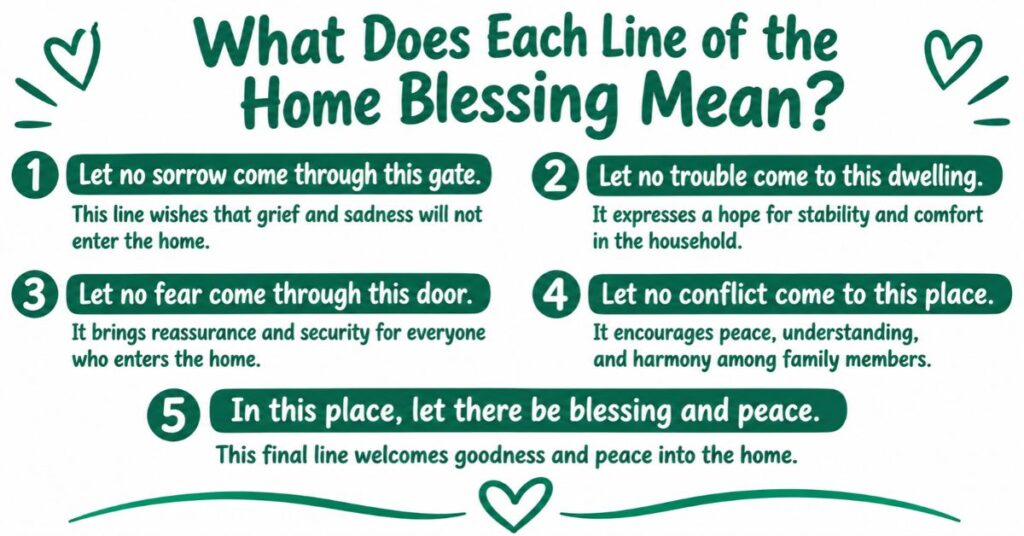
What Does Each Line of the Home Blessing Mean?
The five lines of the Jewish blessing for the home, Birkat HaBayit, describe the kind of atmosphere people hope to maintain in their homes. The first four lines ask that different difficulties stay away, while the final line welcomes blessing and peace. Understanding each expression makes the traditional Jewish house blessing more meaningful.
1. Let no sorrow come through this gate.
The opening line expresses a wish that grief and sadness will not enter the household. The gate represents the entrance to the home, while sorrow represents emotional hardship. It reminds family members to create an environment where happiness, encouragement, and compassion have room to grow.
2. Let no trouble come to this dwelling.
The second line focuses on the home itself. It expresses a desire for stability, comfort, and relief from unnecessary difficulties. Although every family experiences challenges, the blessing reflects the hope that a household will remain a supportive place where people can face problems together.
3. Let no fear come through this door.
This line expresses a wish for reassurance and security. A door represents the boundary between the outside world and the private home. Its message is that people should feel welcome and comfortable when they return to their household, rather than being surrounded by fear or anxiety.
4. Let no conflict come to this place.
The fourth line connects with family relationships and Shalom Bayit. It expresses a hope that arguments, resentment, and unnecessary disagreements will not dominate household life. Its meaning encourages patience, respectful communication, forgiveness, and understanding between people who share the same living space.
5. In this place, let there be blessing and peace.
The final line brings the blessing to a positive conclusion. Instead of focusing on what should remain outside, it welcomes goodness into the home. The Hebrew words Berachah and Shalom represent blessing and peace, two meaningful hopes for a happy and harmonious household.
One interesting feature of the traditional Hebrew wording of the Jewish blessing for the home is its use of similar-sounding words, such as sha’ar and tza’ar. These word relationships give the blessing a memorable rhythm and connect the physical parts of a home with the difficulties that people hope will stay away.
Where Do You Hang a Home Blessing?
A Jewish blessing for the home is commonly displayed inside the house, especially near the main entrance. This location gives family members and visitors an opportunity to see its message when entering or leaving. The entrance also represents the transition between the outside world and the welcoming environment of the household.
Some families choose to hang the Jewish blessing for the home, Birkat HaBayit, beside a window, in a hallway, or in a shared living area. A framed Hebrew blessing can also be placed above a console table or on a wall where family members gather. The location is generally a matter of personal preference rather than a strict religious requirement.
When choosing a display, consider the following:
- Near the entrance: A traditional and noticeable place for the home blessing.
- Living room: A shared space where family and guests can appreciate its message.
- Hallway: A simple location that connects different parts of the house.
- Near a window: A popular decorative choice in many Jewish homes.
- Family gathering area: A meaningful place to remember the importance of peace and kindness.
A Jewish blessing for the home should be displayed respectfully, with care for the Hebrew wording. If you are unsure about appropriate placement for a particular religious text, ask a knowledgeable Jewish educator or rabbi.
How Can You Mark the Moment You Hang It?
Hanging a Jewish blessing for the home can be a meaningful part of moving into a new house or creating a welcoming family environment. Some households choose to read Birkat HaBayit aloud, while others discuss its English translation and share their hopes for the future. The moment can be simple and personal.
There is no universally prescribed installation ceremony or special blessing that must be recited when hanging Birkat HaBayit. This is different from affixing a mezuzah, which has a specific religious blessing. Families can therefore mark the occasion in a way that reflects their own customs and traditions.
For example, parents might explain the five lines of the Jewish blessing for the home to their children and discuss why kindness and understanding matter at home. A couple moving into a new house might read the translation together and make a shared commitment to building a peaceful household.
A new-home gathering can also include family members, close friends, traditional food, and personal wishes for the people living there. These simple activities help connect the physical house with the relationships and values that make it a home.
Is a Home Blessing the Same as a Mezuzah?
No. Birkat HaBayit and a mezuzah have different meanings and religious purposes. Both are associated with Jewish households, and they may be displayed near the same entrance, but they should not be confused with one another. Understanding this distinction is particularly important when learning about traditional Jewish home customs.
A mezuzah is a small case containing a handwritten parchment scroll with passages from the Torah, including the Shema. Its placement on a doorpost is connected with the biblical instruction in Deuteronomy 6:9. A blessing is recited when affixing a mezuzah in circumstances where the commandment applies.
Birkat HaBayit, the Jewish blessing for the home, is a traditional five-line home blessing. It expresses a wish for a household without sorrow, trouble, fear, or conflict. Unlike the mezuzah, it does not contain a Torah scroll and is not itself a biblical commandment.
| Feature | Birkat HaBayit | Mezuzah |
| Meaning | Blessing of the Home | Doorpost |
| Main purpose | Expresses a wish for household peace | Fulfills a Jewish commandment |
| Contents | Five-line Hebrew home blessing | Handwritten Torah parchment |
| Common placement | Inside the home, often near the entrance | On a qualifying doorpost |
| Installation blessing | No prescribed installation blessing | Specific blessing is recited |
| Religious status | Traditional household custom | Biblical commandment |
The distinction matters because a decorative Hebrew blessing cannot replace a kosher mezuzah. Someone preparing a Jewish home should follow the appropriate mezuzah requirements for their tradition rather than assuming that displaying Birkat HaBayit fulfills the same purpose.
Which Home Blessing Should You Give as a Gift?
A Jewish home blessing can be a thoughtful gift for someone moving into a new house, celebrating a marriage, or beginning a new stage of family life. Birkat HaBayit is particularly suitable because its words express hopes for happiness, harmony, and peace. It is a meaningful way to wish someone well without needing an elaborate present.
A Hebrew and English Jewish blessing for the home plaque is one option. It allows the recipient to appreciate the original Hebrew wording while understanding its message through the translation. Some designs use traditional calligraphy, while others feature simple lettering and decorative frames.
Other gift ideas include:
- Framed Birkat HaBayit: A traditional presentation suitable for an entryway or living room.
- Hebrew calligraphy artwork: A decorative way to display the original blessing.
- A handmade plaque: A personal gift for someone who appreciates handcrafted items.
- A home blessing print: A simple option for a new apartment or house.
- A personalized gift card: A handwritten message explaining the meaning of the blessing.
Before choosing a Jewish blessing for the home as a gift, check that the Hebrew wording is accurate. Different versions may contain small variations, so a reliable translation is important. A short handwritten note can explain why you selected the blessing and what you hope it brings to the recipient’s household.
For someone who values Jewish heritage, the most meaningful part of the gift is its message. It expresses the hope that their new home will be filled with kindness, welcoming relationships, and lasting peace.
2. Birkat Habayit for a Blessing Upon Your House
Birkat HaBayit, the Jewish blessing for the home, expresses more than a wish for a comfortable building. It reflects the hope that a household will become a place of emotional support, understanding, and positive relationships. The traditional wording asks that difficult experiences remain outside while blessing and peace become part of everyday family life.
This message is meaningful when people move into a new house, welcome a child, celebrate a marriage, or simply want to create a more peaceful environment. It reminds household members that a happy home is built through everyday actions, including listening, helping, forgiving, and treating one another with respect.
A Personal Blessing Inspired by Jewish Home Traditions
The following is an original English blessing inspired by the themes of Birkat HaBayit. It is not a traditional Hebrew prayer or a replacement for the original text.
May this home be filled with love, patience, and understanding. May everyone who enters find warmth and kindness. May family members support one another through difficult days and celebrate their blessings together. May peace guide every conversation, and may happiness grow within these walls.
Families can use personal words like these when writing a housewarming card or sharing good wishes with someone beginning a new chapter. The original Birkat HaBayit remains a distinct traditional blessing, while personal messages offer another way to express the same values.
Biblical Inspiration for a Peaceful Home
Several passages from the Hebrew Bible connect with the themes of building a meaningful household. They offer additional context for people who want to explore the spiritual importance of wisdom, faith, family, and community.
Exodus 25:8 describes the instruction to make a sanctuary so that the Divine Presence may dwell among the people. This verse can inspire reflection on the idea of creating a home where spiritual values are respected and practiced.
Proverbs 24:3–4 explains that a house is built through wisdom and established through understanding. Its message connects with the everyday choices that help create a stable family environment.
Numbers 24:5 contains the well-known words praising the dwellings of Israel. It offers another connection between Jewish heritage, community, and the importance of home.
These passages are biblical references associated with the home blessing in the Open Siddur Project’s presentation. They are accompanying scriptural texts, not additional lines of the original five-line Birkat HaBayit.
Birkat haBayit (Blessing for the Home)
1. Putting Up The Mezuzah
A mezuzah is one of the most recognizable features of a traditional Jewish home. It consists of a protective case containing a handwritten parchment scroll known as a klaf. The scroll includes the Shema and related passages from the Torah, reminding Jewish household members of their faith and responsibilities.
According to Jewish tradition, a mezuzah is attached to the right doorpost when entering a qualifying room, subject to the relevant religious requirements. Ashkenazi communities generally position it at an angle, while Sephardi communities commonly place it vertically. The appropriate placement can depend on the doorway and the Jewish tradition being followed.
Chabad+1
The Mezuzah Blessing in Hebrew and English
The following blessing is recited when affixing a mezuzah:
Hebrew
בָּרוּךְ אַתָּה יְיָ אֱלֹהֵינוּ מֶלֶךְ הָעוֹלָם אֲשֶׁר קִדְּשָׁנוּ בְּמִצְוֹתָיו וְצִוָּנוּ לִקְבֹּעַ מְזוּזָה
Transliteration
Baruch Atah Adonai, Eloheinu Melech haolam, asher kid’shanu b’mitzvotav v’tzivanu likboa mezuzah.
English translation
Blessed are You, Adonai our God, Sovereign of the universe, who has sanctified us through Your commandments and commanded us to affix a mezuzah.
This is the specific religious blessing associated with installing a mezuzah. It should not be confused with Birkat HaBayit, which is displayed as a traditional home blessing. If a household is unsure about the requirements for a particular doorway, consulting a knowledgeable rabbi is the best approach.
Chabad+1
Frequently Asked Questions
What does the Jewish blessing for the home mean?
Birkat HaBayit, Hebrew for ‘Blessing of the Home,’ is a traditional five-line Jewish blessing that asks for a household filled with peace, happiness, and blessing, and for sorrow, trouble, fear, and conflict to stay away. It reflects the hope for Shalom Bayit, peace in the home.
What is the Hebrew text of Birkat HaBayit in English?
In English, the five lines are: ‘Let no sorrow come through this gate. Let no trouble come to this dwelling. Let no fear come through this door. Let no conflict come to this place. In this place, let there be blessing and peace.’ The Hebrew text begins ‘B’zeh hasha’ar lo yavo tza’ar.’
When is the Jewish home blessing used?
Birkat HaBayit is often displayed when moving into a new house, and it is also given as a gift for housewarmings, marriages, and new stages of family life. Some families read it aloud when hanging it, sometimes as part of a simple family gathering.
What does each line of the home blessing mean?
Each line asks for protection from a different hardship: the gate line asks that sorrow not enter, the dwelling line asks for stability and relief from trouble, the door line asks for reassurance and security, the conflict line asks for family harmony, and the final line turns to a positive wish for blessing and peace in the home.
Where should you place a Jewish home blessing?
A Jewish home blessing is commonly displayed inside the house, especially near the main entrance, and also in a hallway, living room, or near a window. It should be displayed respectfully, with care for the accuracy of the Hebrew wording.
How is Birkat HaBayit different from a mezuzah?
Birkat HaBayit is a traditional blessing, not a biblical commandment, and it is displayed as a decorative plaque or print. A mezuzah is a small case holding a handwritten Torah parchment that is fixed to a doorpost as a commandment, with its own blessing recited when it is affixed. A home blessing cannot replace a kosher mezuzah.