Hebrew House Blessing: Meaning, Prayer & Beautiful Quotes
A Hebrew house blessing is a meaningful expression of hope for a home filled with peace, happiness, safety, and family harmony. One of the best-known examples is Birkat HaBayit, a traditional Jewish home blessing displayed near the entrance of many Jewish homes.
For anyone exploring Jewish traditions, the Hebrew language, or a meaningful housewarming message, understanding this blessing adds depth to the words displayed on a wall. Its message is simple but powerful: a home should be a place where sorrow gives way to joy, disagreements give way to understanding, and every visitor feels welcome.
What is the Jewish home blessing?
The Hebrew house blessing commonly known as Birkat HaBayit (ברכת הבית) translates to “Blessing of the Home.” It is a short Hebrew folk text that expresses a wish for protection, happiness, harmony, and peace within a household. Many families display it on a decorative plaque near their front entrance.
Unlike a formal prayer from the Jewish prayer book, the familiar five-line version is a traditional folk blessing with no known original author. It is appreciated for its beautiful Hebrew wordplay and thoughtful message. Its purpose is to express hope that a home will remain a welcoming place filled with kindness, comfort, and blessing.
Neriela+2
The words are especially meaningful because they address everyday experiences. Every family wants a peaceful place to return to after a difficult day. A home is not simply a building with rooms and furniture; it is where relationships grow, children learn, memories develop, and loved ones find emotional support.
In Jewish culture, the idea of peace within the household is often expressed through the Hebrew phrase Shalom Bayit, meaning peace in the home. It reflects the importance of respect, understanding, patience, and harmony between family members.
What are the words of Birkat HaBayit?
The traditional Hebrew house blessing consists of five short lines. The first four express a wish that sadness, trouble, fear, and conflict stay away from the home. The final line welcomes blessing and peace.
Here is a commonly displayed version with Hebrew vowels, transliteration, and English meaning.
ברכת הבית
Birkat HaBayit – Blessing of the Home
בְּזֶה הַשַּׁעַר לֹא יָבוֹא צַעַר
B’zeh hasha’ar lo yavo tza’ar.
Let no sorrow come through this gate.
בְּזֹאת הַדִּירָה לֹא תָבוֹא צָרָה
B’zot hadirah lo tavo tzarah.
Let no trouble come to this dwelling.
בְּזֹאת הַדֶּלֶת לֹא תָבוֹא בֶּהָלָה
B’zot hadelet lo tavo behalah.
Let no fear come through this door.
בְּזֹאת הַמַּחְלָקָה לֹא תָבוֹא מַחְלוֹקֶת
B’zot hamachlakah lo tavo machloket.
Let no conflict be in this place.
בְּזֶה הַמָּקוֹם תְּהִי בְּרָכָה וְשָׁלוֹם
B’zeh hamakom t’hi v’rachah v’shalom.
In this place, let there be blessing and peace.
A commonly used version of the Jewish home blessing. Minor wording variations exist.
These five lines create a beautiful message for a family. They express a desire to leave hardship outside and make room for kindness, safety, and happiness inside. The blessing is often displayed in Hebrew calligraphy, framed artwork, or a decorative wall hanging.
Birkat haBayit (Blessing for the Home)+1
A simple pronunciation guide
People who do not speak Hebrew can still appreciate and read the blessing. Transliteration provides a way to pronounce the words using familiar English letters.
For example, Shalom is pronounced approximately shah-LOHM, while Berakhah is pronounced beh-rah-KHAH. The Hebrew letter ח (chet) produces a sound that does not have an exact English equivalent.
Pronunciation may vary slightly between Hebrew-speaking communities and transliteration systems. Reading slowly and listening to a knowledgeable Hebrew speaker can help beginners become more comfortable with the words.
What does each line of the home blessing mean?
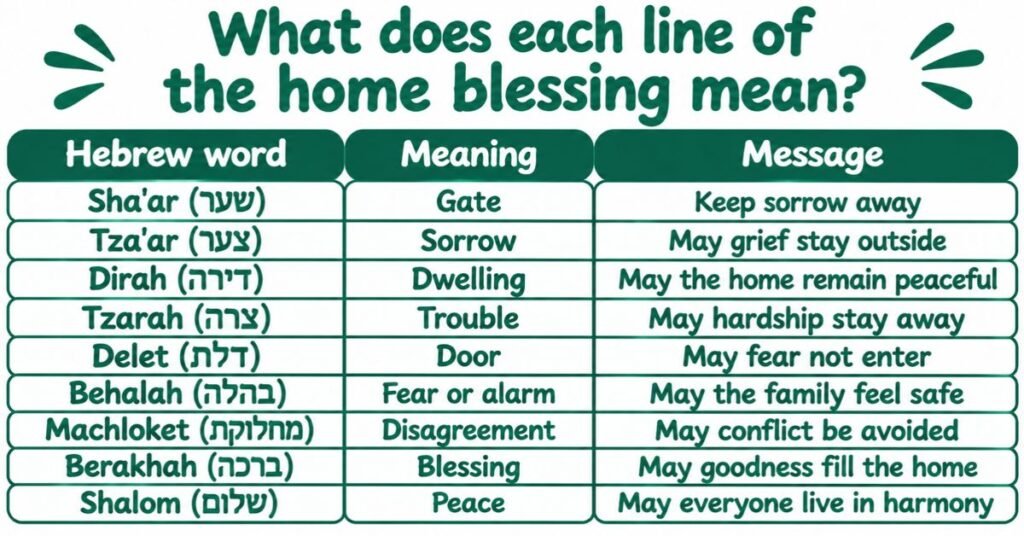
The beauty of Birkat HaBayit becomes clearer when each line is understood individually. Its wording connects different parts of a home with the difficulties people hope to avoid. The repeated sounds make the blessing memorable, while its final line brings the entire message together.
| Hebrew word | Meaning | Message |
| Sha’ar (שער) | Gate | Keep sorrow away |
| Tza’ar (צער) | Sorrow | May grief stay outside |
| Dirah (דירה) | Dwelling | May the home remain peaceful |
| Tzarah (צרה) | Trouble | May hardship stay away |
| Delet (דלת) | Door | May fear not enter |
| Behalah (בהלה) | Fear or alarm | May the family feel safe |
| Machloket (מחלוקת) | Disagreement | May conflict be avoided |
| Berakhah (ברכה) | Blessing | May goodness fill the home |
| Shalom (שלום) | Peace | May everyone live in harmony |
The first line: Let no sorrow come through this gate.
The gate represents the entrance to a household. The Hebrew words sha’ar and tza’ar create a memorable sound relationship. Their message is a heartfelt wish that sadness and grief do not become part of family life.
The second line: Let no trouble come to this dwelling.
The word dirah means dwelling or residence, while tzarah refers to trouble or distress. Together, they express the hope that the household will experience stability, comfort, and relief from unnecessary hardship.
The third line: Let no fear come through this door.
A door is a symbol of entry and welcome. This line expresses the desire for a home where family members feel secure, visitors are welcomed kindly, and frightening experiences do not disturb the household.
The fourth line: Let no conflict be in this place.
The Hebrew word machloket refers to disagreement or conflict. This line is particularly meaningful because even loving families sometimes experience misunderstandings. Its message encourages patience, respectful communication, forgiveness, and reconciliation.
The fifth line: In this place, let there be blessing and peace.
The final line changes the focus from keeping difficulties away to welcoming something positive. Berakhah means blessing, while shalom means peace. Together, they represent a household where love, happiness, good health, and meaningful relationships can flourish.
The five lines create a thoughtful progression: four expressions of hope against hardship followed by one powerful wish for blessing and peace.
Neriela+1
Where do you hang a home blessing?
A Hebrew house blessing is traditionally displayed near the main entrance of a Jewish home. The entrance is a meaningful location because family members and visitors encounter its message when entering the house. Some households place it on the wall beside the mezuzah, while others display it near a window or in a central gathering space.
There is no single compulsory placement for the standard Birkat HaBayit folk text. A family may choose a location where the words are visible and respected. A hallway, living room, or family gathering area can also be appropriate, depending on the household’s customs.
Here are some common placement ideas:
- Near the front entrance: A welcoming reminder of peace and happiness.
- In the living room: A meaningful message for family members and guests.
- In the dining area: A reminder of gratitude, togetherness, and shared meals.
- In a family gathering space: A visible expression of love and understanding.
Some families choose a simple Hebrew plaque, while others prefer a framed blessing with traditional patterns or decorative calligraphy.
If the artwork also contains biblical passages or Divine Names, Jewish customs concerning the respectful treatment of sacred writing may apply. Families should follow their own religious traditions when deciding where to display it.
How can you mark the moment you hang it?
Hanging a Hebrew house blessing can be a meaningful moment, especially when a family has recently moved into a new residence. Although there is no universally prescribed ceremony for displaying the standard Birkat HaBayit text, families can make the occasion special through gratitude, prayer, and togetherness.
One simple idea is to invite family members to read the five lines together. Someone who knows Hebrew can read the original wording, while others follow the English translation. This makes the tradition accessible to children, older relatives, and guests who are unfamiliar with the language.
A family may also share a short personal prayer:
“May this home become a place of kindness, patience, and understanding. May everyone who enters find warmth, every family member find comfort, and every difficult day end with renewed hope. May peace remain within these walls.”
A Jewish new-home gathering is commonly known as Chanukat HaBayit, meaning dedication of the home. It can bring relatives and friends together to celebrate a new beginning. Jewish sources describe this gathering as a meaningful custom associated with gratitude and the beginning of life in a new residence.
Chabad+1
Other thoughtful ways to mark the occasion include:
- Sharing a meal with loved ones.
- Reading a meaningful passage from the Torah.
- Offering personal wishes for the family.
- Expressing gratitude for having a safe place to live.
- Remembering friends and relatives who helped make the move possible.
The most important part is the intention behind the occasion. A home dedication does not need to be elaborate to become a cherished family memory.
Is a home blessing the same as a mezuzah?
No. A Hebrew house blessing and a mezuzah are two different Jewish traditions, even though they may appear near the same entrance.
A mezuzah is a religious object containing a handwritten parchment scroll with specific biblical passages, particularly the Shema and related verses from Deuteronomy. It is attached to the doorpost in accordance with Jewish religious law.
Birkat HaBayit, on the other hand, is a traditional folk blessing that expresses a wish for peace, happiness, and protection within the household. It is generally displayed as decorative Hebrew writing and is not a substitute for the mezuzah.
| Feature | Birkat HaBayit | Mezuzah |
| Meaning | Blessing of the home | Doorpost |
| Main purpose | Expresses a wish for household peace | Fulfills a Jewish religious commandment |
| Physical form | Plaque, print, or wall hanging | Parchment inside a case |
| Placement | Often near the entrance | On the appropriate doorpost |
| Religious status | Folk custom | Religious obligation |
| Text | Commonly five Hebrew lines | Biblical passages |
The mezuzah commandment is associated with Deuteronomy 6:9, which instructs the Jewish people to write the commandments on the doorposts of their homes and gates.
The two traditions can complement one another. One represents a religious commandment, while the other expresses a heartfelt wish for a peaceful household.
Neriela+2
Which home blessing should you give as a gift?
A Hebrew house blessing can be a thoughtful present for someone moving into a new residence, celebrating a wedding, or beginning a new chapter in family life. Its message is universal: may this home become a place of peace, kindness, happiness, and welcoming relationships.
The traditional five-line Birkat HaBayit is a meaningful choice for someone who appreciates Jewish heritage. A Hebrew and English version can be especially helpful when members of the household speak different languages or are learning Hebrew.
Other meaningful choices include:
- A traditional Hebrew home blessing plaque.
- A framed Birkat HaBayit with English translation.
- A decorative Hebrew calligraphy piece.
- A home blessing combined with an appropriate biblical verse.
- A personalized message expressing family love and gratitude.
When choosing a blessing that includes additional biblical passages or Divine Names, consider the recipient’s religious customs. Written sacred texts may require respectful handling and disposal according to Jewish practice.
KotelArtstore+1
Beautiful original Hebrew house blessing quotes
The following are original English-language inspirational quotes, not historical Hebrew prayers or traditional Jewish quotations. They can be used in a housewarming card, family message, or personal reflection.
1. “May every doorway welcome happiness, every room hold kindness, and every heart find peace within this home.”
2. “A blessed home is not measured by its walls but by the love, understanding, and warmth shared within them.”
3. “May this house be a shelter from life’s storms and a place where hope grows stronger every day.”
4. “Let laughter fill the rooms, gratitude brighten the mornings, and peace remain through every season.”
5. “May everyone who enters this home feel welcomed, everyone who lives here feel loved, and everyone who leaves carry a little happiness.”
6. “A peaceful home begins with forgiving hearts, gentle words, and the willingness to understand one another.”
7. “May your home always have enough love to share, enough strength to overcome hardship, and enough joy to celebrate life’s blessings.”
8. “May the light of kindness shine in every corner and the spirit of peace guide every family conversation.”
9. “A home becomes special when ordinary moments turn into beautiful memories shared with the people we love.”
10. “May every new beginning bring hope, every challenge bring wisdom, and every passing day bring another reason to be thankful.”
More short house blessing quotes
These shorter messages work well for greeting cards, wall decorations, and housewarming wishes.
- “May peace live here and love grow here.”
- “Let kindness be the language of this home.”
- “May every visitor leave with a happy heart.”
- “Where love lives, blessings find their way.”
- “May this home always be filled with light.”
- “Let gratitude open every door.”
- “May happiness find a place in every room.”
- “A home filled with love is a home filled with blessings.”
The detail worth knowing when you choose one
An important detail about Birkat HaBayit is that its familiar five-line version does not contain the Divine Name. This is one reason it is commonly displayed as decorative Hebrew writing. However, some longer versions include biblical verses, the Priestly Blessing, or other sacred passages.
When a plaque includes sacred Hebrew text or Divine Names, additional Jewish religious customs may govern how it is handled. In traditional practice, writings containing Divine Names may be treated as shemot and should not simply be discarded with ordinary household waste. The exact requirements can depend on the text and community practice.
Before choosing a Hebrew house blessing, it is helpful to check what is actually written on it. A decorative version containing only the standard five lines is different from an expanded version containing biblical passages. If you are unsure, ask a knowledgeable rabbi about the appropriate treatment of the particular text.
KotelArtstore+1
Why the original Hebrew wording matters
The original Hebrew has a poetic quality that is difficult to reproduce fully in English. Several words are connected through similar sounds, creating a memorable relationship between the place and the difficulty that the blessing hopes to keep away.
For example, sha’ar (gate) and tza’ar (sorrow) sound similar. Likewise, dirah (dwelling) and tzarah (trouble) create a recognizable sound pattern. These connections make the original wording distinctive and meaningful.
Why the Kotel and the blessing keep turning up together
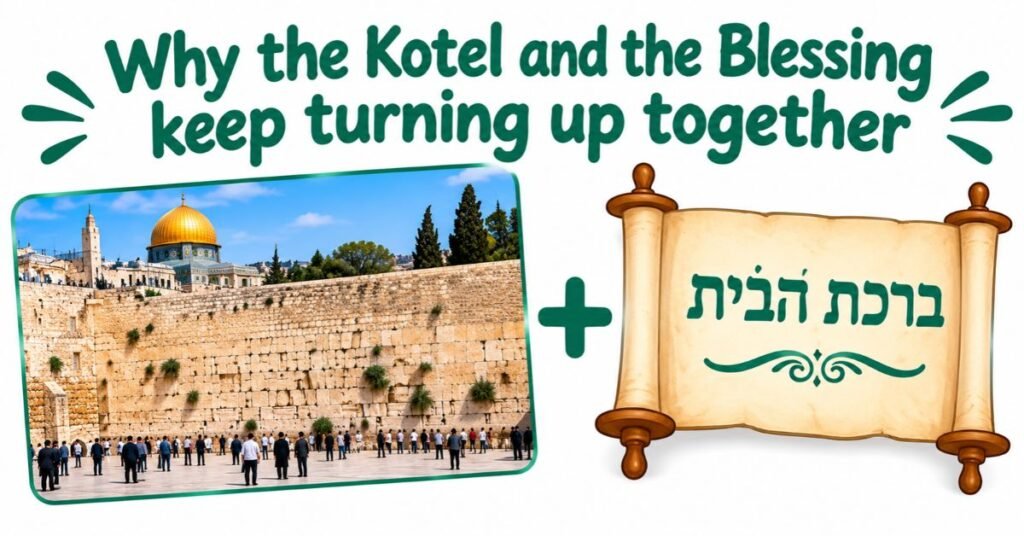
The Kotel, also known as the Western Wall, holds deep spiritual and historical importance in Jewish life. It is a recognizable symbol of Jerusalem and Jewish heritage. Some Jewish homes display Jerusalem-themed artwork alongside a Hebrew home blessing, creating a connection between family life and a wider cultural tradition.
However, the Kotel and Birkat HaBayit serve different purposes. The home blessing expresses a wish for peace within a household, while Jerusalem artwork may represent faith, heritage, memory, and spiritual connection.
For families with a strong connection to Jewish history, these symbols can make an entryway feel particularly meaningful. A home can reflect personal identity through its traditions, religious objects, artwork, and the values that guide the people living inside it.
Biblical verses that complement a home blessing
Several biblical passages express ideas that naturally complement the message of Birkat HaBayit. They are separate scriptural texts, not additional lines of the traditional five-line folk blessing.
“Through wisdom is a house built; and by understanding it is established.”
This passage connects a strong household with wisdom, understanding, and knowledge. It reminds families that a meaningful home is built through thoughtful decisions and good relationships.
Numbers 24:5
“How goodly are thy tents, O Jacob, and thy tabernacles, O Israel!”
This verse celebrates the dwellings of Israel and is often appreciated for its beautiful connection with the idea of a home.
Psalm 127:1
“Except the LORD build the house, they labour in vain that build it.”
This verse offers a reflection on the importance of spiritual purpose and gratitude when creating a home and family life.
Exodus 25:8
“And let them make me a sanctuary; that I may dwell among them.”
This verse connects the idea of a sacred dwelling with the presence of God among the people.
These passages appear alongside Birkat HaBayit in the Open Siddur Project’s expanded presentation of the home blessing. They provide additional biblical context without changing the original five-line wording.
opensiddur.org
Putting Up The Mezuzah
A mezuzah is an important part of establishing a Jewish home. The tradition comes from the Torah’s instruction to write specific commandments on the doorposts of the house and gates.
The parchment inside a mezuzah case contains passages from Deuteronomy 6:4–9 and 11:13–21. These passages emphasize love of God, remembering the commandments, and keeping them close in everyday life.
A blessing is recited when affixing a mezuzah according to Jewish practice. Its Hebrew wording is:
בָּרוּךְ אַתָּה יְיָ אֱלֹהֵינוּ מֶלֶךְ הָעוֹלָם אֲשֶׁר קִדְּשָׁנוּ בְּמִצְוֹתָיו וְצִוָּנוּ לִקְבֹּעַ מְזוּזָה.
Transliteration:
Baruch Atah Adonai Eloheinu Melech HaOlam, asher kid’shanu b’mitzvotav v’tzivanu likboa mezuzah.
English meaning:
Blessed are You, Lord our God, King of the Universe, who has sanctified us with Your commandments and commanded us to affix a mezuzah.
The mezuzah is generally attached to the appropriate doorpost, following Jewish law and the customs of the household. Its presence serves as a reminder of the Torah and the values that guide Jewish family life.
Rabbi.com+1
For someone establishing a Jewish home for the first time, understanding the difference between a mezuzah and a decorative home blessing is especially important. They are complementary traditions, not interchangeable objects.
10. FAQ Section
These questions address the main search-intent themes found in the competitor pages and related searches. They are not presented as verified live Google People Also Ask rankings.
What is the traditional Hebrew house blessing?
The traditional Hebrew house blessing is called Birkat HaBayit. It consists of five lines asking that sorrow, trouble, fear, and conflict stay away while blessing and peace fill the home.
What does Birkat HaBayit mean in English?
Birkat HaBayit means “Blessing of the Home.” Its familiar wording expresses a wish for a household filled with peace, happiness, safety, and harmony.
What are the Hebrew words for a blessing of the home?
The Hebrew name is ברכת הבית (Birkat HaBayit). Its familiar five-line text begins with בזה השער לא יבוא צער and ends with בזה המקום תהי ברכה ושלום.
Where should a Hebrew house blessing be placed?
It is commonly displayed near the front entrance, often on a wall beside the mezuzah. Some families also place it in a living room or another central area.
Is Birkat HaBayit a Jewish prayer?
It is commonly called a Jewish home blessing, but the familiar five-line version is a folk text rather than a formal prayer from the traditional Jewish prayer book.
Is a Hebrew house blessing the same as a mezuzah?
No. Birkat HaBayit is a home blessing usually displayed as decorative writing, whereas a mezuzah contains a handwritten parchment with biblical passages and fulfills a Jewish religious commandment.
Can non-Jewish people display a Hebrew house blessing?
People from different backgrounds may appreciate its message of peace and family harmony. However, anyone displaying Jewish religious writing should understand its cultural meaning and treat sacred texts respectfully.
What is the Jewish tradition for blessing a new home?
A Jewish new-home dedication is commonly called Chanukat HaBayit. Families may gather with friends and relatives, share a meal, offer blessings, and celebrate the beginning of life in their new home.
Does the Hebrew home blessing have a known author?
The original author of the familiar five-line Birkat HaBayit is unknown. Its provenance is uncertain, although a related version appears on a 1925 printed amulet from Hungary.
opensiddur.org+1
What does Shalom Bayit mean?
Shalom Bayit means “peace in the home.” It describes harmony, mutual respect, and understanding among family members.
Can you give someone a Hebrew house blessing as a housewarming gift?
Yes. A Hebrew home blessing can be a meaningful housewarming gift, particularly for someone who appreciates Jewish culture. A version with Hebrew and English wording makes its message easier to understand.
Does Birkat HaBayit contain the name of God?
The familiar five-line version does not contain the Divine Name. However, expanded versions may include biblical passages or other sacred wording, so the exact text should be checked.
What is the traditional Hebrew house blessing?
The traditional Hebrew house blessing is called Birkat HaBayit. It consists of five lines asking that your home be filled with peace, protection, and happiness.
What does Birkat HaBayit mean in English?
Birkat HaBayit means “Blessing of the Home.” Its familiar wording expresses a wish for a household filled with peace, harmony, and protection.
Where should a Hebrew house blessing be placed?
It is commonly displayed near the front entrance, often on a wall beside the mezuzah. Some families display it in a central area of the home, and choosing a careful placement is important when the home blessing contains holy words or the Divine Name.
Is Birkat HaBayit a Jewish prayer?
It is commonly called a Jewish home blessing, but the familiar five-line version is a folk text rather than a formal prayer from the Jewish prayer book.
Is a Hebrew house blessing the same as a mezuzah?
No. Birkat HaBayit is a home blessing usually displayed as decorative writing, whereas a mezuzah contains sacred parchment scrolls with specific biblical passages and follows particular religious rules about its placement.
Can you give someone a Hebrew house blessing as a housewarming gift?
Yes. A Hebrew home blessing can be a meaningful housewarming gift, particularly for someone who appreciates Jewish culture. A version with both Hebrew and English wording makes its message easier to understand.