

Thanks for Your Prayers: 50+ Meaningful Ways to Say It
Thanks for your prayers is one of the hardest simple sentences to write, because four plain words are supposed to carry an entire season of fear, hope, and relief. I’ve helped dozens of families find the right wording after a diagnosis, a surgery, or a loss, and the block is almost always the same: the moment feels too big for a text message. This guide gives you the actual phrasing, a copy-and-adjust template, and the etiquette so you never freeze over a blank card again.
If someone prayed for you during an illness, surgery, loss, or hard season, a short and sincere thank-you note, text, or card is enough. You don’t need a perfect paragraph, and your church family, coworker, or best friend will feel the gratitude even in one honest sentence. Below, you’ll find real examples for every relationship and situation, organized so you can find your exact moment fast.
Thanks for Your Prayers What the Phrase Really Means
When someone says thanks for your prayers, they’re naming something specific: another person paused their day to hold them in mind before God, without asking for anything back. It’s a phrase rooted in spiritual support and intercession, not just politeness, and it carries real emotional weight even between people of different faith traditions. That’s why a generic “thanks!” can feel thin compared to acknowledging the prayer chain, the pastor, or the friend who actually showed up.
Saying it well means naming what the prayers did, not just that they happened. Instead of a flat thank-you, mention the comfort, the strength, or the hope the prayers and thoughts brought you during a specific week or diagnosis. That small shift, from acknowledging the act to naming its effect, is what turns a polite reply into a message someone will actually remember and treasure.
How to Say Thanks for Your Prayers the Right Way
There’s no single correct format: a handwritten note, a text, an email, or a spoken thank-you all work, and the right one depends on your relationship and how personal the update feels. A simple template helps when you’re stuck: greeting, a specific thank-you for the prayers and support, an optional update, and a warm closing like “God bless” or “with gratitude.” Text messages can skip the greeting and closing entirely if that feels more natural.
The one rule that matters across every format is specificity. “Thank you for your prayers during my recovery, I go back to work next week” lands harder than “thanks for praying,” because it proves the prayers were noticed and that they mattered. If the situation is private or an unspoken request, it’s completely fine to keep your wording vague while still sounding heartfelt and grateful.
Short Thanks for Your Prayers Quotes and Messages
Sometimes you need one or two sentences, not a full letter, especially for a quick text or a Facebook comment replying to several people at once. These short lines work as a full message on their own or as the opening of something longer if you want to add an update afterward.
- Thanks for praying for me. I felt every bit of it.
- Thank you for your prayers and support during this difficult time.
- With a grateful heart, thank you for your continued prayers.
- I’m blessed knowing you’re praying for me. Thank you.
- Thank you for keeping me in your thoughts and prayers.
- Your faithful prayers gave me strength I didn’t know I had.
- Thank you for your prayers, love, and kindness. It means everything.
- I felt held by your prayers this week. Thank you, truly.
Thanks for Your Prayers and Support Messages
When a friend has been checking in and praying consistently, a longer message that acknowledges both the friendship and the faith behind it feels more complete. These messages work well as a card, an email, or a longer text once the initial crisis has settled.
Thank you for your prayers and concern these past few months; things are finally improving, and I credit part of that to knowing you never stopped praying. Your friendship and your faith together have carried me more than you probably realize, and I’m genuinely thankful you’re part of my life. Another version: thank you for reminding me of God’s promises when I needed it most, because your prayers gave me both comfort and real, practical hope during a season that felt uncertain.
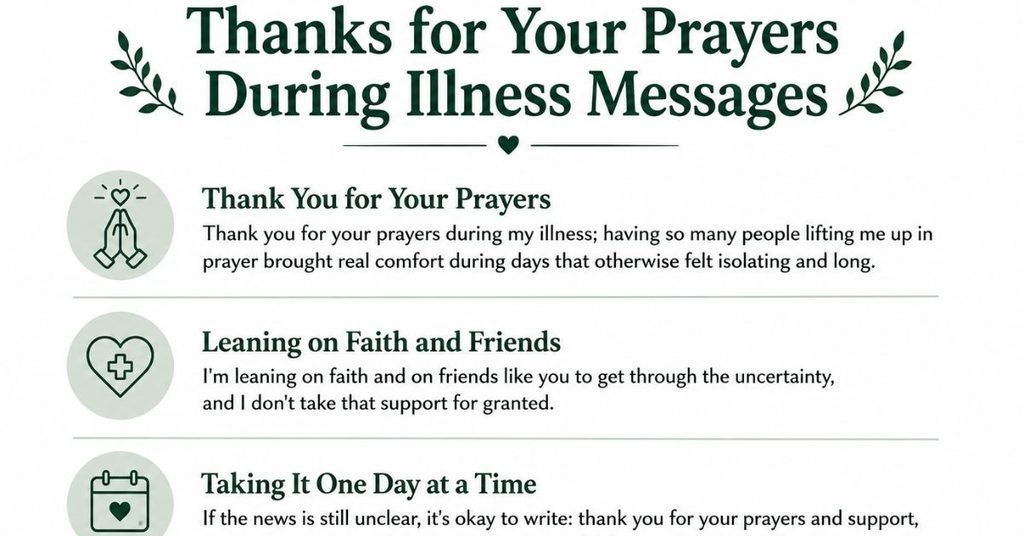
Thanks for Your Prayers During Illness Messages
Illness strips away a sense of control, and hearing that people are praying for your healing restores some of it. These messages are built for a diagnosis, a hospital stay, or an ongoing health struggle, where the update may still be uncertain.
Thank you for your prayers during my illness; having so many people lifting me up in prayer brought real comfort during days that otherwise felt isolating and long. I’m leaning on faith and on friends like you to get through the uncertainty, and I don’t take that support for granted. If the news is still unclear, it’s okay to write: thank you for your prayers and support, we’re taking this one day at a time and grateful for every kind thought sent our way.
Thanks for Your Prayers During Surgery Messages
Surgery thank-yous usually go out to the people who prayed during the actual procedure and the anxious hours in the waiting room. This message often reaches family and close friends who were checking their phones the whole time.
Thank you for your prayers during my surgery; knowing you were praying while I was in the operating room gave my whole family real peace during the waiting. The recovery has been smoother than we expected, and I believe your prayers played a part in that. I’m deeply grateful for your faithfulness through every hour of that day.
Thanks for All the Prayers, Love, and Support Messages
For people who want to be more specific about a hard season, whether it’s grief, job loss, or a mental health struggle, a message that names both the prayers and the practical love behind them feels more honest. This is the version to use when someone did more than pray.
Thank you for all your prayers, love, and support; I know I leaned on you more than I probably said out loud, and I want you to know it did not go unnoticed. Your prayers, combined with the meals, the calls, and the patience, carried me through a season I couldn’t have handled alone. I thank God that you’re in my life, and I pray for you just as faithfully in return.
Thanks for Your Prayers and Condolences Messages
After a death, thank-you notes often combine gratitude for prayers with acknowledgment of condolences, sympathy cards, and support during the funeral. These messages can double as a Facebook post if you’re responding to many people who commented after you shared the loss.
Thank you for your condolences and prayers during this difficult time; your support meant so much to our family as we said goodbye to someone we loved deeply. We know she is at peace now, and your kind words and prayers gave us strength to get through the services and the days after. We are grateful for every person who reached out.
Thank-You Letter to the Church Family for Their Prayers
When an entire congregation, prayer chain, or small group has been praying, a single letter addressed to the church family (often read aloud by the pastor) is more practical than dozens of individual notes. This format keeps the tone warm but slightly more formal.
Dear Friends, we want to thank everyone in our church family who has been praying for us during a difficult season with a loved one’s health. We’ve felt every prayer, every text, and every kind word, and we are so thankful to belong to a community that shows up for each other in faith. With love and gratitude, [Your Family Name].
How to Respond to “Thanks for Your Prayers”
If you’re the one who prayed and someone thanks you for it, the right response is usually short: “of course,” “I’m just glad you’re doing better,” or “I’ll keep praying.” You don’t need to downplay your effort, but you also don’t need an elaborate reply, since the moment belongs to the person who’s grateful, not to you.
A good habit is to gently reaffirm the offer: “I’m still praying for you” or “let me know if you need anything else.” That small addition turns a one-time exchange into an ongoing relationship, which is often exactly what someone going through a hard season needs to hear repeated more than once.
Common Mistakes to Avoid When Saying Thanks for Your Prayers
A few small missteps can make a heartfelt thank-you feel less genuine than it actually is, so it helps to know what to avoid before you hit send.
| Mistake | Why It Falls Flat | Better Approach |
| Waiting weeks to say thanks | Feels like an afterthought | Send even a short note within a few days |
| Copy-pasting a generic quote | Doesn’t mention the person’s specific effort | Reference one detail about their support |
| Downplaying the gesture (“it’s not a big deal”) | Minimizes their genuine care | Simply say it mattered, without qualifiers |
| Never following up later | Leaves the story unfinished | Share an update once things improve |
Thanks for Your Prayers: Final Summary
Knowing that someone is praying for you feels wonderful, but finding the words to say thanks for your prayers back to them can still feel surprisingly hard in the moment. The examples, template, and etiquette above are meant to remove that pressure so you can focus on the relationship instead of the wording.
Whatever format you choose, a handwritten card, a quick text, or a letter to your whole church family, sincerity will always matter more than polish. Pick the message closest to your situation, adjust it with one true detail, and send it; that’s genuinely all a heartfelt thank-you for prayers needs to be.
FAQ Section
What do you say when someone thanks you for your prayers? A simple “of course” or “I’m glad you’re doing better” is enough. You can add “I’m still praying for you” if the situation is ongoing, since that reassures them the support hasn’t stopped.
How do you say thank you for prayers and support in a text? Keep it short and specific: “Thank you for your prayers and support this week, it truly helped.” Texts don’t need a greeting or closing, so you can skip straight to the gratitude.
What’s a good Bible verse to include when saying thanks for prayers? Philippians 1:3 (“I thank my God every time I remember you”) and James 5:16, which speaks to the power of prayer, are commonly included in thank-you notes for prayers.
Is it appropriate to thank people for prayers on social media? Yes. A short caption acknowledging that you felt supported works well when many people commented on a post about your situation, and it lets everyone know at once without individual replies.
What should I write in a thank-you card for prayers during illness or surgery? Name the specific situation, describe how the prayers helped (comfort, strength, peace), and close with a short update if you’re comfortable sharing one. Specificity is what makes the card feel personal rather than generic.